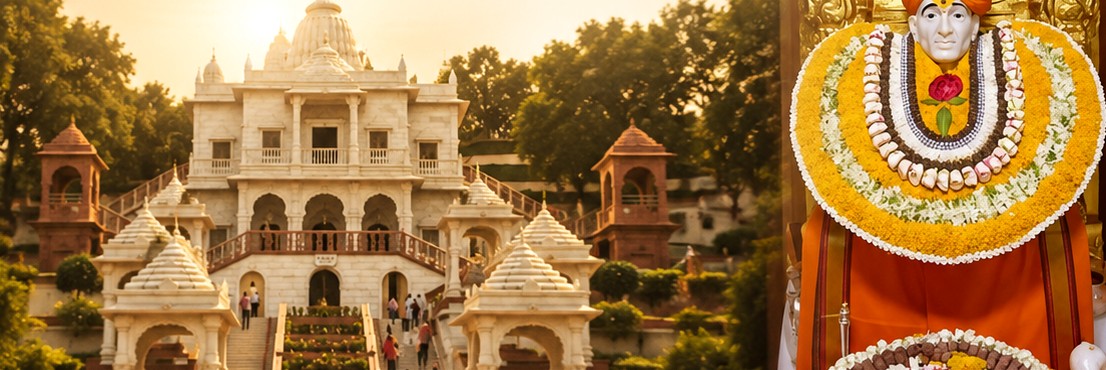
Few places in India carry the layered sanctity of Omkareshwar — one of the twelve Jyotirlingas, set on an island shaped like the sacred syllable Om in the holy Narmada river, in the Khandwa district of Madhya Pradesh. Understanding the Omkareshwar Jyotirlinga history and its mythology adds profound depth to any visit. This guide explores the significance, legend, and living spiritual life of the temple, and the place of Gajanan Maharaj Sansthan within it.
Why Omkareshwar Is Significant
The significance of Omkareshwar rests on three pillars that few other temples can claim together.
A Jyotirlinga of Shiva
Omkareshwar is honoured as one of the 12 Jyotirlingas — the most sacred abodes of Lord Shiva across India. A Jyotirlinga is not merely a stone symbol; it is regarded as a direct manifestation of Shiva as an infinite column of light, a formless presence that chose to dwell in specific places for the welfare of devotees. Pilgrims travel across the country to complete the circuit of these twelve; see our list of the 12 Jyotirlingas and their locations to understand where Omkareshwar fits.
The Om-Shaped Island
The island on which the temple stands — known as Mandhata or Shivpuri — is naturally shaped like the sacred symbol “Om” (ॐ) when viewed from above. The Narmada curls around it in a way that traces the curves of the syllable, an extraordinary geographical coincidence that has been revered for millennia. This is explored further in our guide to the Om-shaped island of Omkareshwar. To stand on an island that physically embodies the cosmic sound is, for many pilgrims, the most powerful aspect of the visit.
The Holy Narmada
The island sits in the Narmada (Reva), one of the seven sacred rivers of Hinduism and the only one traditionally worshipped not just by bathing in her, but by circumambulating her entire course. The significance of the Narmada (Reva) river is unique — she is considered a living goddess, and her presence elevates every ritual performed on her banks. Read more in our guide to the significance of the Narmada river.
The Legend of the Jyotirlinga’s Origin
The Omkareshwar temple story is rooted in a beloved legend from the Shiva Purana, centred on the devotion of the Vindhya mountain.
According to tradition, Mount Vindhya — the great range that separates north and south India — once felt humbled by the greater fame of Mount Meru, the mythic cosmic peak. To grow in spiritual stature, Vindhya performed intense tapas (austerities) and worshipped Lord Shiva, fashioning a Shivalinga of clay and sand on the island in the Narmada. Pleased by the mountain’s single-pointed devotion, Shiva appeared before it in the form of a divine Jyotirlinga and granted two boons: that Vindhya would grow in grandeur, and that the Jyotirlinga would remain on the island for all time, to be worshipped as Omkareshwar — the Lord of the Om.
A fuller telling of the legend appears in our dedicated Omkareshwar Jyotirlinga story and legend guide.
The Meaning of the Name
The name Omkareshwar is itself a teaching. “Om” is the primordial sound from which, in Hindu philosophy, the entire universe is said to have arisen — the vibration that underlies all creation. “Ishwar” means Lord or sovereign. To utter the name is to invoke Shiva as the Lord of the cosmic sound itself, the stillness from which all movement proceeds.
The Two Jyotirlingas — Omkareshwar and Mamleshwar
A distinctive feature of Omkareshwar is that it comprises two Jyotirlinga temples, both considered equally sacred:
- Omkareshwar, on the island itself, is the primary shrine, reached by boat or footbridge.
- Mamleshwar (also called Amareshwar), on the south bank of the Narmada, is the second, quieter temple.
Tradition holds that the presence of Shiva is divided between the two — some accounts say the Jyotirlinga manifests at Omkareshwar by night and at Mamleshwar by day. Most pilgrims complete darshan at both to honour the pairing. Read our Mamleshwar vs Omkareshwar guide for the full comparison.
Omkareshwar in the Puranas and Ancient Texts
Omkareshwar is not only a place of living worship — it is deeply embedded in Hindu scripture and legend.
- The Shiva Purana describes the origin of the Jyotirlinga through Vindhya’s devotion.
- The Skanda Purana, in its Reva Khanda section, contains extensive hymns to the Narmada and the glories of Omkareshwar.
- References in the Ramayana and Mahabharata establish the antiquity of the Narmada as a sacred river of pilgrimage.
- Saint-poets of the Bhakti movement, including those of the Narmada tradition, have sung the praises of the island for centuries.
A fuller account of these textual references appears in our Omkareshwar in the Puranas and ancient texts guide.
The Place of the Narmada Parikrama
No treatment of Omkareshwar’s significance is complete without mentioning the Narmada parikrama — the unique tradition of circumambulating the river itself. The short island parikrama of around 5–8 km can be completed in a few hours, while the full Narmada parikrama of roughly 2,600 km takes several months and is one of the most austere pilgrimages in Hinduism. Our Narmada parikrama guide covers both.
The Role of Gajanan Maharaj Sansthan
The Gajanan Maharaj Sansthan at Omkareshwar is dedicated to Gajanan Maharaj, the revered saint whose best-known tradition is at Shegaon, Maharashtra. He is remembered for his extraordinary simplicity, his compassion for all beings, and above all his lifelong dedication to anna-daan — the feeding of devotees and the hungry, seeing the Divine in every visitor.
It is important to note that Gajanan Maharaj was not born in Omkareshwar, nor did he take samadhi here; his historical life and tradition centre on Shegaon. The Omkareshwar Sansthan is dedicated to him and inspired by his teachings — carrying forward, in a Jyotirlinga tirtha, the same spirit of selfless service, simplicity and feeding that defined his life. The Sansthan’s community kitchen (Anna Kshetra), seva opportunities and modest pilgrim accommodation all flow from this founding inspiration. Read more in our guide to the teachings and legacy of Gajanan Maharaj.
Living Significance — Why Pilgrims Still Come
For all its antiquity, Omkareshwar is not a monument — it is a living tirtha. Pilgrims come today for many reasons:
- To complete darshan of one of the 12 Jyotirlingas.
- To bathe in the Narmada and perform tarpana for ancestors.
- To undertake the island parikrama or, for the rare few, the full river parikrama.
- To experience the evening aarti with its floating lamps on the water.
- To perform Rudrabhishek and other pujas on auspicious days.
- To serve through seva and anna-daan, in the spirit of Gajanan Maharaj.
Visiting Omkareshwar Today
If the history calls you, plan your visit with the help of these guides:
- How to reach Omkareshwar for routes and distances.
- Best time to visit for the right season.
- Bhakt Niwas accommodation for a comfortable stay near the temple.
Conclusion
The significance of Omkareshwar is woven from geography, scripture and living devotion — a Jyotirlinga on an Om-shaped island in the goddess Narmada, born from a mountain’s tapas and sung by the Puranas. Add to this the spirit of Gajanan Maharaj Sansthan, with its emphasis on seva, simplicity and the feeding of all, and Omkareshwar becomes more than a destination. It becomes an invitation to step out of ordinary time and into the eternal rhythm of the sacred.
Frequently Asked Questions
Why is Omkareshwar considered a Jyotirlinga?
Omkareshwar is revered as one of the twelve Jyotirlingas — the spots where Shiva is believed to have manifested as a column of divine light. Its island in the Narmada, shaped like the sacred Om, is considered an exceptionally powerful manifestation of this presence.
What is the meaning of the name Omkareshwar?
The name derives from 'Om' — the primordial sound of creation — and 'Ishwar', meaning Lord. Omkareshwar thus means the Lord of the Om, the divine who resides in the sacred syllable itself.
What is the significance of the Om-shaped island?
The island of Mandhata, on which the temple stands, is naturally shaped like the sacred symbol Om when viewed from above. This rare geographic form is seen as a sign of Shiva's own presence embedded in the land.
Who is Gajanan Maharaj?
Gajanan Maharaj is a revered Hindu saint whose best-known tradition is at Shegaon in Maharashtra, associated with simplicity, compassion, anna-daan (feeding) and devotion. The Omkareshwar Sansthan is dedicated to him and inspired by his teachings.