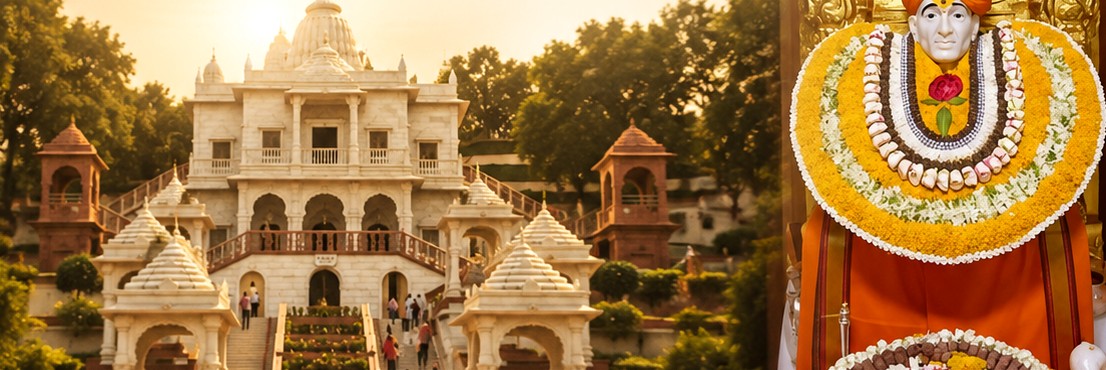
Few places on Earth carry their sacred identity as visibly as the Om-shaped island of Omkareshwar. Here, in Khandwa district of Madhya Pradesh, the Narmada river splits and flows around a small island in a curve that — seen from above — recalls the form of the sacred syllable “Om” (ॐ). It is this rare convergence of geography and mantra that gives Omkareshwar its name and its place among the twelve Jyotirlingas of Lord Shiva.
The Geography of the Mandhata Island
The sacred island at Omkareshwar is known by several names — Mandhata island, Omkar island, or the Omkareshwar island — all referring to the same stretch of elevated land between two channels of the Narmada. Rather than flowing past in a single straight line, the river here splits and curves, sweeping around the island in a distinctive shape.
This is not a casual resemblance. The river’s natural path encloses the island in a manner that, from an elevated or aerial view, mirrors the contours of “Om” — the seed-syllable (bija mantra) that, in Hindu thought, is held to be the cosmic sound from which all creation arose.
What the Island Looks Like — A Sacred Sketch
| Feature | Description |
|---|---|
| Shape | Resembles the Devanagari “Om” (ॐ) from above |
| River | The Narmada splits and curves around the island |
| Main temple | Omkareshwar Jyotirlinga, on the island itself |
| Twin shrine | Mamleshwar (Amareshwar), on the south bank |
| Parikrama path | Circles the perimeter of the island |
| Surroundings | Hills, ghats, ashrams and smaller shrines |
For pilgrims, the experience is layered — what the eye sees from the ghats, the heart recognises as a cosmic symbol written in water and stone.
Why the “Om” Shape Matters
The Sacred Syllable
In the Hindu tradition, “Om” is not simply a sound. It is regarded as the nada brahman — the primordial vibration from which the universe emerged. It opens and closes the most important Vedic mantras, and meditation on it is considered a complete spiritual path in itself. That a natural island should echo this form is, for devotees, no accident but a sign of the divine residing here.
A Name Born of Form
The word Omkareshwar literally means “the Lord (Ishwara) of the syllable Om.” According to tradition, the very geography of the place announced its sanctity: where the river shaped itself into Om, there the Lord manifested as a Jyotirlinga. To understand the deeper mythic background, see our article on Omkareshwar’s history & spiritual significance.
The Narmada and the Island Together
The significance of the island cannot be separated from the river that shapes it. The Narmada is one of the seven sacred rivers of India and the only major river traditionally believed to flow from east to west. Pilgrims hold that the Narmada herself is a living goddess, and her presence is central to the spiritual power of Omkareshwar.
Because the river embraces the island on every side, the parikrama — the circumambulation of the island — is at once a walk around the Jyotirlinga and a journey in the company of the Narmada. This is a rare and powerful combination at any tirtha. The Omkareshwar parikrama route guide explains the path in detail.
Walking the Island — The Parikrama Perspective
While the complete “Om” shape is best appreciated from above, pilgrims who undertake the parikrama gain a different, no less sacred, sense of the island’s form. As they walk, the river is rarely out of sight — sometimes close enough to touch, sometimes glimpsed through trees or shrines. The path passes ancient temples, ashrams and stone steps, each adding to the sense that the entire island is a single, living mandala.
Key markers along the route include small shrines, meditation points, and ghats where pilgrims pause to offer prayers to the Narmada. The journey is best done at an unhurried pace, with time to absorb the silence and the river’s murmur.
The Sacred and the Scientific
Devotees do not need science to confirm what faith already knows, but the geography of the island is genuinely remarkable. The split in the Narmada and the curve around Mandhata island is a natural feature shaped over millennia by the river’s flow. That this natural curve should so closely echo a sacred symbol is, for many, a beautiful meeting of the visible and the invisible — a place where the land itself seems to chant the name of the Divine.
For more on the river herself and her place in Indian spiritual life, see our article on the significance of the Narmada (Reva) river.
A Symbol Made of Water and Stone
What makes the Om-shaped island so powerful is that it speaks in many languages at once. To the pilgrim, it is a place of darshan and prayer. To the philosopher, it is a meditation on the cosmic syllable. To the artist, it is a natural sculpture carved by river and time. And to the weary traveller, it is simply a beautiful, peaceful island where the heart can rest.
Summary
The Om-shaped island of Omkareshwar is one of the most striking examples of sacred geography in India. As the Narmada splits and curves around the Mandhata island, it forms a shape that echoes the primordial syllable “Om”, giving this Jyotirlinga tirtha both its name and its unique spiritual resonance. Combining natural beauty, mantra, river and temple, the island offers every devotee a rare chance to walk through a living symbol of the Divine.
Frequently Asked Questions
Why is Omkareshwar called Omkareshwar?
Omkareshwar takes its name from the sacred syllable 'Om'. The Narmada river flows around the island in a shape that, seen from above, resembles the Devanagari 'Om' (ॐ), giving the temple and the town their name.
What is the Mandhata island?
The Mandhata island — also called Omkar or Omkareshwar island — is the sacred river island in the Narmada on which the Omkareshwar Jyotirlinga temple stands. It is named after King Mandhata, a legendary devotee of Lord Shiva.
Can you see the Om shape from the ground?
The full Om shape is best appreciated from an elevated or aerial view. From the ghats and the parikrama path, pilgrims sense the river's curve enclosing the island, but the complete form is clearest from above.