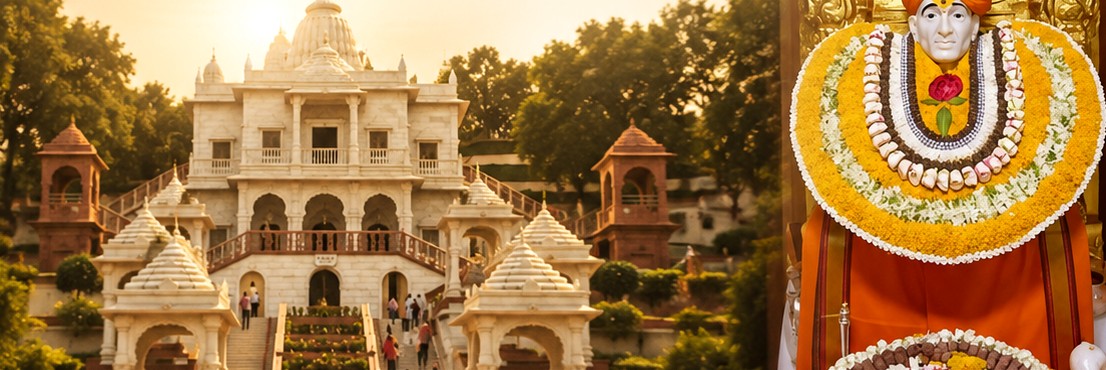
Among the saints of Maharashtra, few lives are as intriguingly undocumented — and as powerfully felt — as that of Sant Gajanan Maharaj of Shegaon. This Gajanan Maharaj biography, drawn entirely from tradition and the accounts handed down by early devotees, tells of an ascetic who appeared in a small Vidarbha town in 1878, revealed nothing about his origins, and spent roughly three decades teaching through sheer presence, simplicity and compassion before taking samadhi in 1910. For the pilgrims who flock to Buldhana district, and for our own Sansthan in Omkareshwar which is dedicated to him, his life is less a historical record than a living story of bhakti — told and retold with reverence, and always with the quiet caveat: according to tradition.
A Sudden Appearance in 1878
According to tradition, the first sighting of Gajanan Maharaj at Shegaon occurred in February 1878, in the vicinity of premises associated with a devotee named Bankatlal. Those who saw him were struck by an unusual sight: a nearly naked, radiant ascetic gathering discarded leaf-plates and leftover food, treating remnants others had thrown away with strange reverence — even pressing them to his body. When questioned, he gave no account of himself. He had simply appeared, as if from nowhere, and the townspeople could not place him in any known family, sect or village.
Devotees interpret this first appearance as a teaching in itself: nothing in this world, and no person, is so low that it deserves contempt. The incident, whatever its precise details, became the seed of the Prakat Din festival still celebrated at Shegaon, usually in February, on dates that vary with the Hindu calendar.
The Ascetic No One Could Place
In the years that followed, Maharaj made Shegaon his home, resting at times in gardens, temples and open spaces around the town. His age was never established; estimates by early devotees varied widely, and tradition holds that he deflected every inquiry about his birth or background with silence or a gentle turn toward God. What could not be missed was the growing circle of people who felt drawn to him — villagers, merchants, farmers and, in time, devoted attendants who served him and recorded whatever they observed.
It is through such devotees that any account of Maharaj survives at all. The stories they preserved — of his absorption in meditation, his indifference to heat, cold and hunger, and his affection for the poor — form the backbone of hagiographies compiled in later decades. Read as history, they are fragments; read as tradition, they describe a life wholly given to the divine.
A Life of Simplicity and Anna Daan
If one theme runs through every account of Maharaj’s years at Shegaon, it is the sanctity of food and feeding. He is remembered for accepting alms with equanimity, for blessing humble meals, and above all for insisting that no visitor or devotee should go hungry. According to tradition, he associated the act of eating and feeding with remembrance of God, turning the most ordinary necessity into devotion.
This ideal found permanent expression after his lifetime in the great Annakshetra at Shegaon, where free meals are served to thousands of pilgrims daily. The ethic behind it — that anna daan, the gift of food, is among the highest forms of seva — is one Maharaj embodied personally, and it is the same spirit that animates community kitchens at pilgrimage centres across India, including the bhandara traditions we describe in our article on anna daan and bhandara seva.
Stories Handed Down by Devotees
The oral tradition around Maharaj is rich with accounts of healings, premonitions and uncanny occurrences — devotees speak of illnesses cured, of his seeming presence in more than one place, and of gentle rebukes that redirected lives. Precise details vary from telling to telling, which is the nature of oral tradition, and this article deliberately avoids inventing dialogue or fixing unverifiable specifics.
What consistently emerges across the stories is a portrait rather than a chronology: a saint of few needs and immense compassion, indifferent to honour, accessible to the poorest, and consumed by love of the divine name. Devotees consider his continued presence at Shegaon to be a matter of direct experience rather than belief, and it is this conviction that fills the Samadhi Mandir with pilgrims every day of the year.
Mahasamadhi in 1910
According to tradition, Gajanan Maharaj consciously left his mortal body at Shegaon in 1910, in the Bhadrapada period of the Hindu calendar, usually corresponding to September. Accounts hold that he indicated his approaching departure to close devotees, and that he was entombed at the site where the Samadhi Mandir now stands. The anniversary of this departure is observed as Punyatithi, one of the two great festivals of Shegaon, drawing enormous gatherings each year.
The years immediately after 1910 belong to his devotees: they safeguarded the samadhi site, organised formal worship, and laid the foundations of the institution now known as Sri Gajanan Maharaj Sansthan. That story — of how a simple tomb became a magnificent marble temple and a multifaceted charitable trust — is traced in our article on the history of the Gajanan Maharaj Samadhi Mandir.
A Tradition-Based Timeline
Because Maharaj’s life is known through tradition rather than documentation, the timeline below is deliberately hedged. The two anchor points — the appearance of 1878 and the mahasamadhi of 1910 — are tradition-based dates that devotees universally accept.
| Period (Approx.) | Event (According to Tradition) |
|---|---|
| February 1878 | First appearance at Shegaon; later celebrated as Prakat Din |
| 1878–1900s | Years of wandering presence in Shegaon; circle of devotees grows |
| Early 1900s | Maharaj largely resident at Shegaon; feeding of visitors becomes a hallmark |
| September 1910 | Mahasamadhi; entombment at the present sanctum site |
| After 1910 | Devotees build the shrine; the Sansthan takes shape and expands |
Summary
The life of Gajanan Maharaj resists biography in the modern sense: no birth date, no hometown, no documented genealogy — only an appearance at Shegaon in 1878, according to tradition, three decades of radiant simplicity, and a departure in 1910 that devotees describe as conscious and foretold. What remains is the essence his followers preserved: feed the hungry, remember God’s name, treat all beings with reverence. His teachings and their living legacy, explored further in our article on Gajanan Maharaj’s teachings and legacy, continue to shape the Annakshetra, the festivals and the daily darshan at Shegaon — and inspire the seva we practise at our Omkareshwar Sansthan in his name.
Frequently Asked Questions
When and where did Gajanan Maharaj first appear?
According to tradition, Gajanan Maharaj was first noticed at Shegaon in Buldhana district, Maharashtra, in February 1878. He was reportedly seen collecting discarded leaf-plates in a manner that startled onlookers, and no one could say where he had come from. The exact date is a matter of tradition and is celebrated annually as Prakat Din, usually in February.
Why is so little known about Gajanan Maharaj's early life?
Tradition holds that Maharaj never revealed his birthplace, caste, family or age, and deflected all such questions toward devotion to God. Whatever accounts exist were preserved orally by early devotees and later compiled by followers. This very obscurity is seen by devotees as part of his message that the divine matters more than identity.
When did Gajanan Maharaj leave his mortal body?
According to tradition, Maharaj took mahasamadhi at Shegaon in 1910, and the anniversary is observed as Punyatithi, usually falling in September. The site of his samadhi became the sanctum of the present Samadhi Mandir. Devotees regard him as ever-present at Shegaon despite his physical departure.