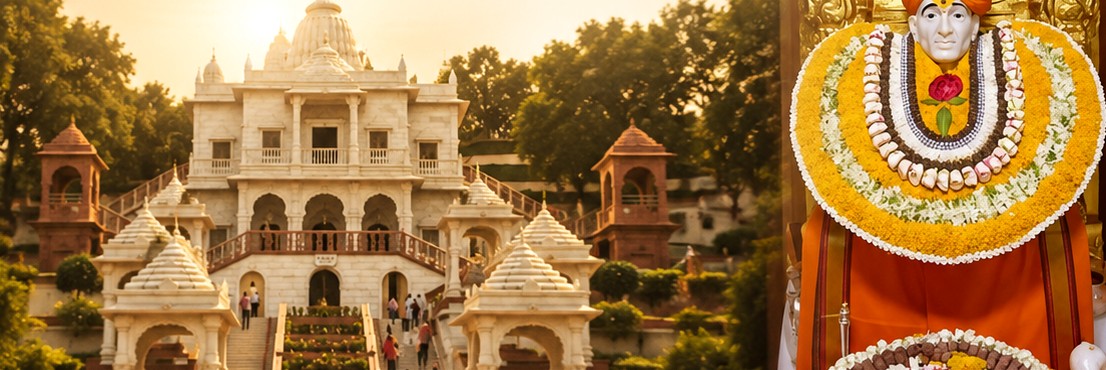
Visitors to this sacred stretch of the Narmada are often surprised to learn there are two Jyotirlingas at Omkareshwar — the Omkareshwar temple on the island and the Mamleshwar (also called Amareshwar or Mamleleshwar) temple on the south bank. This guide clarifies the difference between the two, their significance, and how to plan darshan at both.
Why Are There Two Jyotirlingas Here?
The Omkareshwar–Mamleshwar pairing is one of the distinctive features of this pilgrimage. According to a widely followed tradition, both shrines together represent the single Jyotirlinga of this kshetra (sacred region) — one enshrined on the island (Omkareshwar) and the other on the mainland south bank (Mamleshwar/Amareshwar). Pilgrims therefore consider a visit complete only when both have received darshan.
For the mythological background of these shrines, read our story and legend of the Omkareshwar Jyotirlinga.
Omkareshwar — The Island Temple
The Omkareshwar temple stands on Shivapuri island (also called Mandhata), the island in the Narmada whose shape is traditionally likened to the sacred sound “Om”. This is the principal temple of the kshetra and the one most associated with the name “Omkareshwar”.
Highlights
- A tall shikhara visible from the ghats, marking the sanctum of the Jyotirlinga.
- Reached by a walk across a connecting bridge or by boat from the north bank.
- The starting point of the famous island parikrama.
For current opening hours and aarti details, see our darshan timings and aarti schedule guide.
Mamleshwar (Amareshwar) — The South Bank Temple
The Mamleshwar temple sits on the south bank of the Narmada, directly across from the island. It is variously referred to as Amareshwar, Mamleleshwar or Mamaleshwar in different texts and local usage, but all refer to the same south-bank shrine. The temple is older in architecture and quieter than the island temple, with beautifully carved stone walls and a deeply peaceful sanctum.
Highlights
- Ancient stone architecture with intricate carvings.
- A more tranquil, less crowded atmosphere than the island temple.
- Counted as the second Jyotirlinga of the kshetra in tradition.
Mamleshwar vs Omkareshwar — At a Glance
| Feature | Omkareshwar | Mamleshwar (Amareshwar) |
|---|---|---|
| Location | Island in the Narmada | South bank of the Narmada |
| Status | Principal Jyotirlinga of the kshetra | Counted as the second Jyotirlinga |
| Architecture | Larger temple complex, tall shikhara | Older stone carving, compact sanctum |
| Crowd level | Usually busy | Generally quieter |
| How to reach | Bridge or boat from the ghats | Direct road access on the south bank |
How to Visit Both Temples
The two temples are close, and visiting both in a single day is straightforward. Common approaches:
- Bridge route: A connecting bridge links the north bank to the island, so you can walk to Omkareshwar, have darshan, and then cross the river to the south bank for Mamleshwar.
- Boat crossing: Boats ply regularly between the ghats and the island. A short boat ride also connects the island side to the south bank, which is a lovely way to experience the Narmada.
- During parikrama: Pilgrims performing the island parikrama naturally cover the Omkareshwar shrine and often conclude with darshan at Mamleshwar.
For the full circular route, see our Omkareshwar parikrama route guide.
Tips for Visiting Both
- Sequence: Most pilgrims begin at the island Omkareshwar temple, then cross to Mamleshwar; doing both in the morning avoids the midday heat and crowds.
- Boat timing: Boats run through the day but thin out after sunset — finish crossings before dusk.
- Dress and conduct: Both are active places of worship; wear modest, traditional clothing and avoid leather items inside the sanctum.
- Combined darshan time: Allow roughly 2–3 hours for a relaxed darshan at both temples, plus some time for the boat crossing and parikrama if planned.
- Festival rush: During Maha Shivratri and Shravan Mondays, queues at the island temple can be long — visit Mamleshwar during the peak rush for a calmer experience.
Significance in the Wider Pilgrimage
Within the twelve Jyotirlingas, the Omkareshwar kshetra is the only one where tradition explicitly pairs two shrines as a single Jyotirlinga, symbolising the unity of the island and the mainland, the visible and the hidden. This duality gives the pilgrimage a special depth — a reminder that the divine presence is not confined to one place.
Summary
The difference between Mamleshwar and Omkareshwar is simply one of location within the same sacred kshetra: Omkareshwar is the island temple, while Mamleshwar (Amareshwar) stands on the south bank. Both are revered as Jyotirlingas, both are easy to visit via bridge or boat, and darshan at both completes the pilgrimage to this Om-shaped island on the Narmada.
Frequently Asked Questions
What is the difference between Omkareshwar and Mamleshwar?
Omkareshwar is the Jyotirlinga temple on the island in the Narmada, while Mamleshwar (also called Amareshwar or Mamleleshwar) is the Jyotirlinga temple on the south bank. Both are counted among the twelve Jyotirlingas in tradition.
Are Omkareshwar and Mamleshwar both Jyotirlingas?
Yes. According to widely followed tradition, both the island Omkareshwar temple and the south-bank Mamleshwar temple are revered as Jyotirlingas, and pilgrims are encouraged to visit both.
How do I visit both Omkareshwar and Mamleshwar?
The two temples are close, connected by a bridge and by boat services across the Narmada. Most pilgrims visit the island temple first and then cross to Mamleshwar, or do the island parikrama and finish at the south bank.