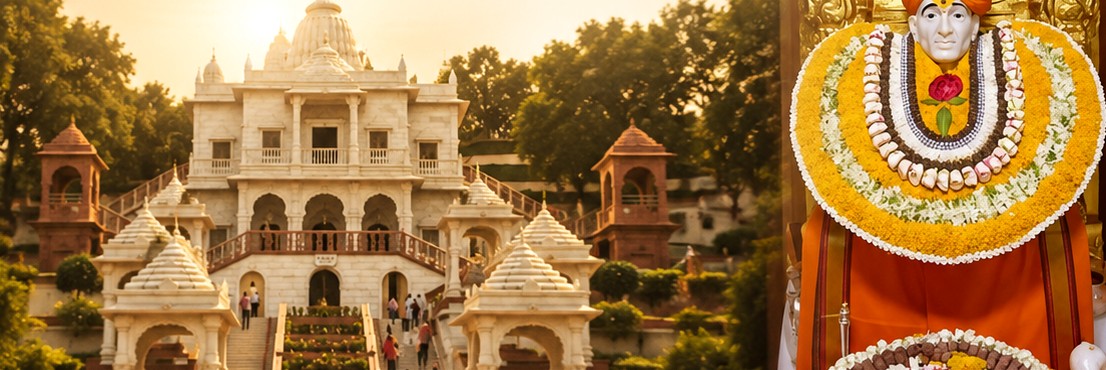
Among the saints of modern India, Gajanan Maharaj occupies a beloved place. His best-known tradition is at Shegaon in Maharashtra, where — according to tradition — he appeared as a mysterious, unassuming figure in the late 19th century. Yet his influence reaches far beyond any one town. The Gajanan Maharaj Sansthan at Omkareshwar is dedicated to and inspired by his example, carrying his ideals of simplicity, compassion and service into the heart of one of the twelve Jyotirlingas of Lord Shiva.
The Mysterious Saint of Shegaon
What is known of Gajanan Maharaj comes largely from devotional accounts and the recollections of his early devotees. According to tradition, he appeared at Shegaone sometime in the late 19th century — a gaunt, serene figure, indifferent to worldly comfort, often absorbed in silent communion with the Divine. He spoke little of his origins, and over time a circle of devotees gathered around him, drawn by the palpable peace of his presence.
His most enduring tradition rests at Shegaon, where a large temple and annakshetra — a centre for the continuous offering of food — now serve countless devotees every year. We are careful here to honour fact: Gajanan Maharaj was not born, did not live his earthly life, and did not take samadhi at Omkareshwar. The Omkareshwar Sansthan draws inspiration from his teachings rather than claiming any biographical connection to this sacred Jyotirlinga tirtha.
The Core Teachings
Simplicity as a Spiritual Path
Gajanan Maharaj’s life, as preserved in tradition, was a lived teaching of simplicity. He accepted what came without craving more, slept where he could, and ate what was offered. For pilgrims today — caught in the rush of modern life — this example is itself a quiet revolution: that the soul thrives not in accumulation but in freedom from want.
Anna Daan — Feeding All Without Distinction
Perhaps the teaching most closely associated with Gajanan Maharaj is anna daan, the free offering of food. He is remembered for insisting that no one who comes in hunger should be turned away. This ideal — feeding all without distinction of caste, wealth or status — became the foundation of the large annakshetra at Shegaon, and it is the same ideal that animates the community kitchen and bhandara seva at the Omkareshwar Sansthan. Devotees who wish to take part can read our anna daan & bhandara seva guide.
Equanimity and Inner Stillness
Tradition holds that Gajanan Maharaj moved through joy and insult, comfort and hardship, with the same unshaken calm. This equanimity (samabhaava) is a hallmark of advanced spiritual life in the Indian tradition — the sign of one whose sense of self has dissolved into the Divine. For devotees, his example offers encouragement amid the inevitable ups and downs of life.
Devotion and Surrender
Above all, Gajanan Maharaj is remembered for his unwavering devotion. Whether his attention turned to Lord Vitthal, to the formless Divine, or to the suffering beings around him, the underlying current was one of total surrender. His silence was not absence but fullness — a life lived in the constant awareness of the sacred.
Stories That Carry His Grace
While we keep specific biographical details hedged — written records being limited and devotional narratives often symbolic — a few recurring themes appear in stories of Gajanan Maharaj:
| Theme | What the Story Reveals |
|---|---|
| Feeding the hungry | The primacy of anna daan and compassion |
| Healing or blessing a devotee | The power of grace flowing through surrender |
| Remaining unmoved by insult or praise | Equanimity as a mark of the realised |
| Silent absorption in prayer | The centrality of inner communion with the Divine |
| Compassion for animals and the poor | That the Divine dwells in all beings alike |
These stories are not told as historical facts to be debated, but as windows into a way of being — a life so emptied of ego that only love remained.
How the Omkareshwar Sansthan Carries This Legacy
The Gajanan Maharaj Sansthan at Omkareshwar exists to translate these timeless teachings into living practice. Its activities reflect the saint’s core ideals:
- A community kitchen that serves pilgrims with dignity, in the spirit of anna daan.
- Bhakt Niwas rooms that offer shelter to those who travel from afar to visit the Jyotirlinga.
- Festival celebrations that gather devotees in shared worship and joy.
- Volunteer seva that allows each devotee to offer time and skill in service.
This is the form in which Gajanan Maharaj’s teachings continue to flow at Omkareshwar — not as relics of the past, but as present, breathing practice. Those who feel moved to contribute their time can explore the seva opportunities & volunteer guide.
A Saint for Our Times
What makes Gajanan Maharaj so beloved, even a century and more after his appearance at Shegaon, is the accessibility of his path. He asked not for scholarship, nor for wealth, nor for elaborate ritual. He asked for a sincere heart, a simple life, and a hand open to those in need. In an age of distraction, this message feels more relevant than ever.
Devotees who visit Omkareshwar — whether for Jyotirlinga darshan, for the parikrama, or for the peace of the Narmada ghats — often find that the ideals associated with Gajanan Maharaj deepen their experience. The river teaches surrender; the Om-shaped island teaches the sacred hidden in form; and the saint’s example teaches the simple, daily art of compassion. For more on the wider spiritual context of this tirtha, see our article on Omkareshwar’s history & spiritual significance.
Summary
Gajanan Maharaj remains one of the most beloved saints of modern India — a figure of simplicity, compassion, equanimity and unwavering devotion. His best-known tradition is at Shegaon in Maharashtra, and we are careful to note that his life and samadhi belong there, not at Omkareshwar. The Omkareshwar Sansthan is dedicated to his inspiration, carrying his ideals forward through anna daan, shelter for pilgrims, festival seva and quiet devotion. In honouring his teachings, devotees find not only a saint to revere but a path to live by — one simple, compassionate act at a time.
Frequently Asked Questions
Who was Gajanan Maharaj?
Gajanan Maharaj was a revered Indian saint whose best-known tradition is centred at Shegaon in Maharashtra. According to tradition, he appeared there in the late 19th century and became known for his simplicity, compassion and silent spiritual power.
What is Gajanan Maharaj most famous for?
He is especially associated with feeding all without distinction (anna daan), with childlike simplicity, with equanimity in all circumstances, and with an unspoken inner communion with the Divine.
Is Gajanan Maharaj's samadhi at Omkareshwar?
No. Gajanan Maharaj's best-known tradition and the large temple associated with him are at Shegaon in Maharashtra. The Omkareshwar Sansthan is dedicated to and inspired by his teachings, not the site of his life or samadhi.