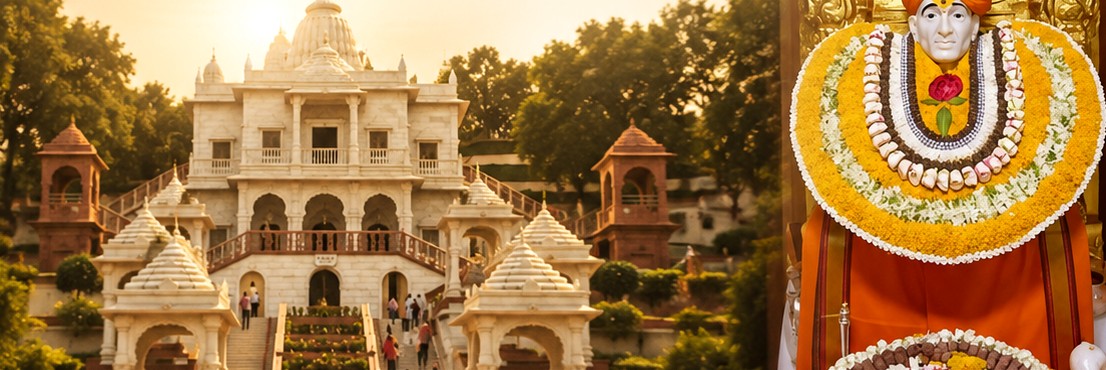
The Omkareshwar Jyotirlinga story is one of devotion, divine grace and the symbolism of the sacred sound Om. Set on an island in the Narmada river, this shrine’s legend centres on the penance of Mount Vindhya and the moment Lord Shiva chose to manifest here as Omkara — a form identified with the primordial syllable itself.
The Legend of Mount Vindhya’s Penance
According to the most widely told legend, Mount Vindhya — the personified deity of the Vindhya mountain range — grew troubled by a sense of rivalry with the mighty Himalayas, long favoured by the gods. Seeking a blessing that would raise him in glory, Vindhya began a long and austere penance devoted to Lord Shiva.
For many years the mountain-god worshipped Shiva, fashioning a lingam of clay and sand (in some versions, of parthiv — earth) and chanting the sacred name. Pleased by this unwavering devotion, Lord Shiva appeared before Vindhya and granted boons. At the deity’s request, Shiva agreed to dwell permanently at this spot on the Narmada, manifesting as the Omkara Jyotirlinga — a self-arisen (Swayambhu) column of light inseparable from the sound Om.
The two forms
Tradition holds that Shiva manifested in two forms at this kshetra:
- Omkareshwar — on the island in the Narmada.
- Mamleshwar (Amareshwar) — on the south bank.
This is why pilgrims revere both temples as parts of the single Omkareshwar Jyotirlinga, a pairing unique among the twelve.
Why the Name “Omkareshwar”
The name Omkareshwar derives from Omkara, the form of Shiva identified with the syllable Om — considered the root sound of creation in Hindu thought. Two strands of meaning converge here:
- The form of Shiva: Shiva as Omkara is the divine embodied in sound, the essence from which all mantra arises.
- The shape of the island: The island on which the temple stands, formed by the branching of the Narmada, is traditionally said to resemble the Devanagari symbol “Om” (ॐ) when viewed from above.
For more on this remarkable geography, see our article on the Om-shaped island of Omkareshwar.
The Role of the Narmada
The Narmada river is inseparable from the Omkareshwar legend. One of India’s seven sacred rivers, the Narmada is itself considered a living goddess — Reva, “the leaping one” — and is uniquely believed to be worshipped not by bathing in her but by her mere presence. The presence of a Jyotirlinga on her island deepens the sanctity of the entire region, making Omkareshwar a confluence of two forms of the divine: the linga of light and the river of grace.
Scriptural References (Hedged)
The twelve Jyotirlingas are traditionally enumerated in a verse found in the Shiva Purana (and echoed in related texts such as parts of the Linga Purana and the Mahabharata). The verse names Omkareshwar (in some recensions, “Mamaleshwar”) among the twelve. The exact wording, location details and number of verses vary across manuscripts and regional recensions, so it is best to treat the scriptural references as broadly authoritative rather than verbatim fixed. Local sthala puranas (temple legends) of Omkareshwar add further detail about Vindhya’s penance and Shiva’s boons, and these oral and written traditions shape the rituals still performed today.
Omkareshwar Among the Twelve Jyotirlingas
Within the list of twelve, Omkareshwar holds a special place for its union of river and mountain symbolism. While many Jyotirlingas are set on hilltops or in forests, Omkareshwar sits embraced by water — an island that the Narmada seems to cradle. This setting reinforces the legend: a mountain deity (Vindhya) sought the blessing of Shiva, and the blessing was placed not on a peak but within a river, humbling pride and honouring devotion.
For the complete list and context, see our guide to the 12 Jyotirlingas and their locations.
Rituals That Keep the Legend Alive
Several practices at Omkareshwar are direct expressions of the legend:
- Parthiv puja: Worshipping Shiva with lingams made of earth, echoing Vindhya’s original offering.
- Abhishek and Rudrabhishek: Ritual bathing of the Jyotirlinga, believed to confer the very boons Vindhya sought.
- Narmada parikrama: Circumambulating the island or the river, acknowledging the union of the linga and the goddess-stream.
- Recitation of Om: Chanting the syllable Om at the shrine, connecting the devotee to the form of Shiva as Omkara.
A Reverent Note on the Inner Meaning
At its heart, the legend of Omkareshwar teaches that sincere devotion humbles even the proudest. Vindhya, a mountain of immense scale, sought greatness not through force but through worship — and Shiva responded by making this place eternally sacred. For the pilgrim, the story is an invitation: to approach the Jyotirlinga not as a tourist but as a devotee, carrying the same patience and one-pointedness that earned the mountain-god his boon.
For more on the shrine’s broader significance, see our article on Omkareshwar’s history and spiritual significance.
Summary
The Omkareshwar Jyotirlinga story — of Mount Vindhya’s long penance and Shiva’s appearance as Omkara — explains both the name and the unique island-river setting of this sacred shrine. Revered in the Shiva Purana and alive in the daily rituals of the temple, the legend reminds every pilgrim that devotion, humility and the sound of Om open the doorway to the divine presence enshrined on the Narmada.
Frequently Asked Questions
What is the legend behind the Omkareshwar Jyotirlinga?
The most popular legend tells of Mount Vindhya's intense penance to please Lord Shiva, who then appeared as Omkara (the embodiment of the sacred sound Om) and chose to reside here as a Jyotirlinga on the Narmada river.
Why is Omkareshwar called Omkareshwar?
The name comes from 'Omkara', a form of Lord Shiva identified with the sacred syllable Om. The island on which the temple stands is traditionally said to be shaped like the Om symbol.
How is Omkareshwar related to the 12 Jyotirlingas?
Omkareshwar is one of the twelve Jyotirlingas listed in traditional texts, revered as a self-manifested (Swayambhu) form of Shiva. In this kshetra, both the island Omkareshwar and the south-bank Mamleshwar temples are counted.