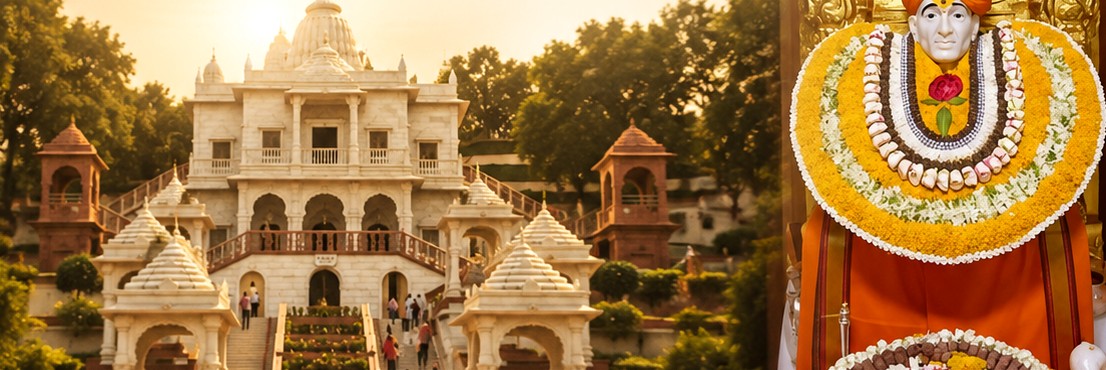
Every great pilgrimage town has at its centre a single sacred point, and at Shegaon that point is the Samadhi Mandir of Sant Gajanan Maharaj. The history of the Gajanan Maharaj Samadhi Mandir is, in essence, the history of Shegaon itself: a quiet Vidarbha town transformed, over the century following the saint’s departure in 1910, into one of Maharashtra’s most visited shrines. This article traces that transformation — from a simple tomb tended by grieving devotees to a marble mandir surrounded by an Annakshetra, gardens and institutions — while keeping firmly in view that the dates of the saint’s life are tradition-based, accepted and cherished by devotees rather than documented by historians.
From Samadhi to Shrine
According to tradition, Gajanan Maharaj consciously left his mortal body at Shegaon in September 1910, in the Bhadrapada period of the Hindu calendar. His body was entombed at the site where the sanctum stands today, and close devotees — the same circle that had served him in life — began offering worship at the spot. In the years immediately following, the samadhi became a gathering point for pilgrims from the surrounding villages of Buldhana district, then from across Vidarbha, and eventually from all of Maharashtra.
The full story of who Maharaj was, how he appeared at Shegaon in 1878 without any traceable origin, and how his circle of devotees formed, is told in our biography article on Gajanan Maharaj’s life according to tradition. What matters here is what his devotees built after him: an enduring centre of faith, organised with a devotion as practical as it was deep.
The Building of the Mandir
The temple took shape in stages, funded and driven by devotees. Early structures around the samadhi gave way to a larger mandir, and successive phases added marble work, an enlarged hall for darshan, and facilities for the growing crowds. The Sansthan — Sri Gajanan Maharaj Sansthan, Shegaon — emerged as the administering body, coordinating worship, festivals, feeding and eventually education and social service. Rather than a single royal patron or a one-time construction, the mandir is best understood as an accretion of countless small offerings, which devotees consider entirely fitting for a saint who owned nothing.
| Phase (Approx.) | Development (Indicative) |
|---|---|
| 1910 onward | Samadhi site tended by devotees; regular worship begins |
| Early decades | Early shrine structures; steady growth of pilgrim flow |
| Mid 20th century | Sansthan consolidation; expansions of the mandir complex |
| Recent decades | Marble work and enlarged facilities; Annakshetra scaled up; Anand Sagar developed |
Exact dates for each phase are not the point of the place, and where numbers matter — darshan hours, festival schedules — you should always confirm with temple authorities as schedules change.
Architecture and Atmosphere
Architecturally, the Samadhi Mandir is dignified rather than towering: a white temple whose visual richness comes from marble, carved pillars and the devotion of its crowds rather than extravagant scale. The sanctum is deliberately restrained — the canopied samadhi, layered with flowers and silver offerings given by generations of pilgrims, forms the heart of the structure. Darshan is managed in flowing queues through the central hall, and on ordinary days the atmosphere is intimate; you are never far from the samadhi itself.
Devotees often describe the temple’s mood as both lively and deeply still — bhajans rising from one corner, near-silence around the sanctum. The complex around the mandir reinforces this balance: the Annakshetra’s clatter of thalis, the quieter prayer halls, and the shaded courtyards where families rest between darshan and meals. For practical details on hours, aartis and queue management, see our Shegaon Gajanan Maharaj darshan guide.
The Sansthan’s Growth Around the Temple
The Samadhi Mandir never remained merely a temple. Under the Sansthan’s stewardship, Shegaon acquired an ecosystem of pilgrimage: the vast Annakshetra serving free meals to thousands daily; accommodation complexes for pilgrims; and, in recent decades, the Anand Sagar (Anand Vihar) garden-and-spiritual complex that gives families a place to spend an entire day. The Sansthan also runs educational institutions and hostels in and around Shegaon, extending the saint’s concern for the poor into modern social service.
This growth has a spiritual logic for devotees: Maharaj’s teachings centred on feeding the hungry and remembering God, so the institutions that grew around his samadhi do exactly those two things, at ever larger scale. The mandir is the soul; the Annakshetra, schools and gardens are its working limbs.
Significance for Pilgrims Today
For the devotee, the significance of the Samadhi Mandir is simple and profound: it is the place where a saint who asked for nothing is permanently available to everyone. Pilgrims come with every variety of need — gratitude, grief, petitions, vows — and the tradition of the place holds that Maharaj’s presence at Shegaon did not end in 1910. The uninterrupted stream of visitors, the flowers that arrive daily, and the continuous free kitchen are treated as evidence of an ongoing relationship rather than a memory.
It is this same relationship that our own Sansthan in Omkareshwar honours: dedicated to Gajanan Maharaj, we serve pilgrims on the banks of the Narmada in the spirit of seva he exemplified. Many travellers combine the two destinations — his samadhi at Shegaon and the island Jyotirlinga at Omkareshwar — in a single yatra across the heart of India.
Summary
The Samadhi Mandir at Shegaon began, according to tradition, as the tomb of an ascetic who appeared from nowhere in 1878 and departed in 1910, leaving no possessions and no descendants — only devotees. Over the following century, their offerings raised a marble temple over the samadhi, and their organised seva built around it an Annakshetra, accommodation, gardens and schools administered by the Sri Gajanan Maharaj Sansthan. To visit today is to stand inside a century of accumulated devotion. Plan your darshan with our timing and aarti guide, and let the history deepen the experience of a place where, devotees believe, nothing really ended in 1910.
Frequently Asked Questions
When was the Gajanan Maharaj Samadhi Mandir built?
According to tradition, Gajanan Maharaj left his body in 1910 and was entombed at the site of the present sanctum. The shrine developed gradually after his mahasamadhi as devotees organised worship around the samadhi, and the mandir was later expanded and beautified in stages by the Sansthan. Precise construction dates for each phase are best confirmed with the Sansthan.
What is inside the sanctum of the Shegaon Samadhi Mandir?
The sanctum houses the samadhi of Sant Gajanan Maharaj, canopied and draped with flowers and silver adornments. Devotees file past in managed queues, taking darshan from the hall around the sanctum. Photography is generally not permitted inside the temple.
Who manages the Samadhi Mandir today?
The temple is administered by Sri Gajanan Maharaj Sansthan, Shegaon, a charitable trust that also runs the Annakshetra, the Anand Sagar complex and various educational and social institutions. The Sansthan manages darshan queues, festivals, free meals and accommodation for pilgrims.