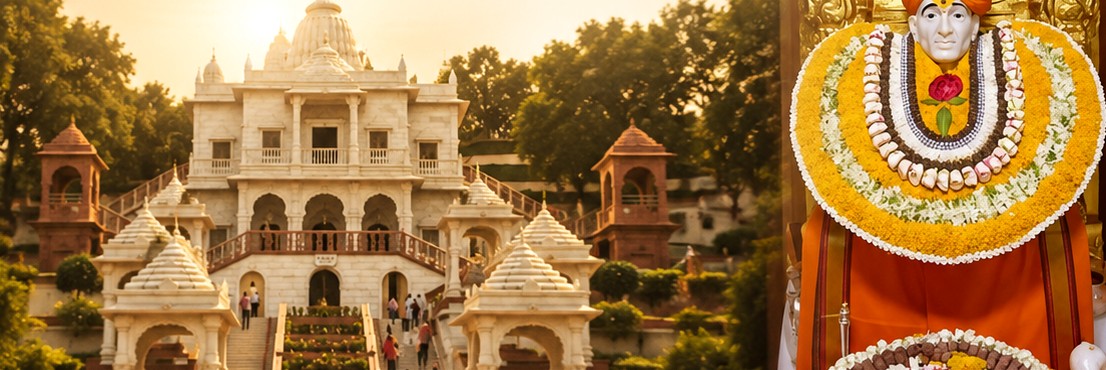
High on a hill in Marathwada’s Dharashiv (Osmanabad) district rises the shrine that Maharashtra’s mothers have whispered to their children about for centuries. Tulja Bhavani of Tuljapur — the Devi who is kuladevi to countless families, the goddess to whom Chhatrapati Shivaji Maharaj is bound in legend and in history, and one of the great Shakti Peethas of the tradition. Roughly 45 to 55 kilometres from Solapur and approximately 280 to 300 kilometres from Pune, the temple crowns the Yamunachala hill in a swirl of bells, banners and unshakeable faith. This darshan guide from our team at Gajanan Maharaj Sansthan, Omkareshwar — a trust named for a saint who embodied the Devi’s own fierce grace — covers the temple’s significance, darshan flow, timings and routes.
The Goddess of Yamunachala
According to tradition, the devi manifested at Tuljapur as Tulja Bhavani to destroy the demon who had tormented the devout Anubhuti — a widow of sage Kardama whose unwavering devotion and courage called the Mother down to earth. Pleased by her bhakti, the goddess is said to have chosen to dwell on the hill, honoured thereafter as Tulja Bhavani, and the hill itself carries the name Yamunachala in the tradition’s telling. The sanctum’s swayambhu murti — the goddess in her three-eyed, eight-armed form, resplendent with vermilion — receives a river of pilgrims from Maharashtra, Karnataka and Telangana alike.
For millions, Bhavani is not a deity visited but a family member honoured: the kuladevi whose thread runs through generations of marriages, harvests and housewarmings. That intimacy amid grandeur is Tuljapur’s signature.
Shivaji Maharaj and the Bhavani Sword
No association illumines Tuljapur like that of Chhatrapati Shivaji Maharaj, for whom Bhavani was the family deity and, by every account, the axis of his inner life. According to tradition, the great king was blessed by the goddess at Tuljapur, and in the most beloved telling she bestowed upon him the Bhavani talwar — the sword named for her, with which his campaigns are inseparably linked in memory and ballad. Historians debate the details, as historians rightly do, but in the hearts of the Marathi people the bond is settled fact: Maharaj belonged to Bhavani, and Bhavani to Maharashtra.
The temple’s history runs deeper still, with patronage across centuries of dynasties — the Yadavas and later the Bhonsles among those remembered in local accounts — and its stone courts have witnessed both coronation-era fervour and quiet village vows.
Darshan Flow and Timings
| Quick fact | Detail (approximate/indicative) |
|---|---|
| Location | Tuljapur, Dharashiv (Osmanabad) district, Marathwada |
| Distance from Solapur | 45–55 km, about 1–1.5 hours by road |
| Distance from Pune | 280–300 km, 6–7 hours by road |
| Opening | Around 4 AM in many seasons; closes late evening |
| Peak crowds | Navratri, Dussehra, Fridays, Purnima days |
A typical darshan day begins well before sunrise: the temple opens around 4 AM in many seasons, with kakada aarti lighting the sanctum, followed by abhishek and naivedya through the morning, and shejaarti folding the day to rest at night. The darshan route moves through the temple’s great stone courts — up the steps of the ghati, past the deep-selling stalls and the chowkie where the goddess’s silver palanquin rests — into the sanctum where the murti glows with sindoor. Free darshan queues run through the day, and the temple offers paid darshan and abhishek options whose indicative fees run from tens to a few hundred rupees — confirm current arrangements and rates with temple authorities at the time, as both change.
Practical notes for the flow:
- Enter via the ghati steps from the town below; autos and private vehicles use the upper approach road.
- Leave phones and leather items as directed — the sanctum line prohibits them.
- Fridays and Purnimas are the busiest ordinary days; Navratri is another order of magnitude.
- Accommodation ranges from bhakta niwas rooms and lodges in Tuljapur (indicatively INR 600 to 2,500 per night) to better hotels in Solapur — book ahead for Navratri and confirm at booking.
Navratri: The Devi’s Own Season
During Sharadiya Navratri, Tuljapur becomes one of the great spectacles of Devi worship in India. Lakhs of pilgrims — by common estimate the crowd runs into the lakhs over the nine days, though numbers vary year to year — climb the hill through decorated streets, with continuous aarti, bhajan mandalis through the night, and the temple lit like a constellation. Queues on such days are measured in hours; the town’s every courtyard becomes a dormitory. If you go for Navratri, go prepared: book everything ahead, carry minimal luggage, keep hydration close and elders’ needs in mind, and build a full day of patience around the darshan. If you go to avoid crowds, choose ordinary weekdays between October and February, when the darshan flows smoothly and the hill’s quiet returns.
How to Reach Tuljapur
Solapur is the practical gateway: approximately 45 to 55 kilometres away by road, with the region’s best rail connectivity on the Mumbai–Solapur–Chennai corridor and steady MSRTC buses and shared taxis plying to Tuljapur in roughly one to one and a half hours. From Pune, the drive of approximately 280 to 300 kilometres takes six to seven hours, most of it along the Solapur highway. The nearest commercial airports are Pune and, more conveniently for some schedules, the Chh. Sambhajinagar (Aurangabad) side at an indicative 190 to 210 kilometres — verify current flight options when booking.
Pilgrims often weave Tuljapur into a larger Marathi devotional arc. To the west, Mahalaxmi of Kolhapur is the Devi tradition’s other great sovereign seat, and the Tuljapur–Kolhapur pairing is a classic. Eastward and northward, the Shirdi–Pandharpur–Shegaon circuit carries devotees through Vitthal’s Chandrabhaga and Gajanan Maharaj’s Samadhi at Shegaon; Pandharpur itself lies within an hour or two’s drive of Tuljapur and the two are very commonly combined. And for those whose devotion embraces the elephant-faced Lord as well, the Ashtavinayak Yatra makes a natural Maharashtra pilgrimage prelude before travelling on — as many families do — to our own Omkareshwar on the Narmada.
Summary
Tulja Bhavani of Tuljapur is Maharashtra’s great Shakti Peetha — the kuladevi of families and of Chhatrapati Shivaji Maharaj, who per tradition received her blessing and her sword. Reach her hill via Solapur, 45 to 55 kilometres away, or from Pune over approximately 280 to 300 kilometres; time your visit between October and February, arrive early for the smoothest darshan, and if Navratri calls you, arrive prepared for crowds worthy of the Devi’s own court. Come with the family vow, the child’s name, or simply an empty pocket of worry — Tulja Bhavani, as her children will tell you, has never turned a devotee away.
Frequently Asked Questions
What is the significance of Tulja Bhavani temple at Tuljapur?
Tulja Bhavani is revered as one of Maharashtra's principal Shakti Peethas and as the kuladevi, or family deity, of countless Maharashtrian households and of the Bhonsle line of Chhatrapati Shivaji Maharaj. According to tradition, the goddess manifested here on the Yamunachala hill after slaying a demon that tormented a devout woman.
How far is Tuljapur from Solapur and Pune?
Tuljapur lies approximately 45 to 55 kilometres from Solapur and roughly 280 to 300 kilometres from Pune by road. Most pilgrims travel via Solapur, which has the nearest major railway station and the best bus and taxi connections.
What are the darshan timings at Tulja Bhavani temple?
The temple traditionally opens well before dawn — around 4 AM in many seasons — and closes by late evening, with the day punctuated by kakada aarti, abhishek, naivedya and shejaarti. Schedules change with festivals, especially Navratri, so confirm current timings with temple authorities.
When is the best time to visit Tuljapur?
October to February offers comfortable weather, with Sharadiya Navratri transforming the town into a vast festival of devotion. If you prefer shorter queues, avoid Navratri, Dussehra, Fridays and full-moon days; for the full fervour of the Devi's court, those are exactly the days to go.