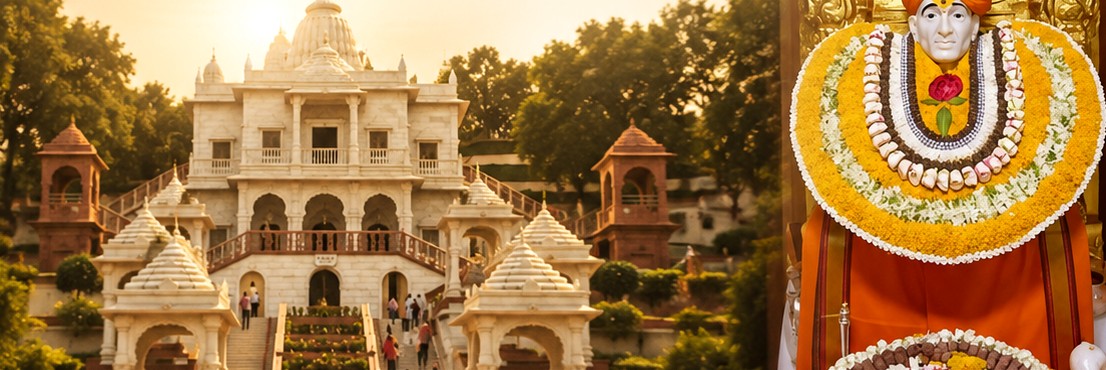
Maharashtra is, acre for acre, one of the richest pilgrimage landscapes on earth, and three of its greatest shrines — Shirdi, Pandharpur and Shegaon — line up into a natural grand tour. Sai Baba’s samadhi, Vitthal’s city on the Chandrabhaga, and Gajanan Maharaj’s seat at Shegaon together tell the story of Maharashtra’s living bhakti tradition, from the varkari saints to the twentieth-century masters. This guide lays out the complete Maharashtra spiritual circuit in 4 to 6 days, with distances, transport choices, a day-by-day itinerary and the best season to travel.
Why These Three Sacred Towns
Each stop on the circuit completes the others. Shirdi holds the samadhi of Sai Baba, the fakir who unified Hindu and Muslim devotion until his passing in October 1918 and whose message of shraddha and saburi still draws millions. Pandharpur is Vitthal’s own city — the destination of the wari, the walking pilgrimage that has rolled across Maharashtra every monsoon for centuries, and the spiritual home of saints like Jnaneshwar and Tukaram. Shegaon preserves the memory of Gajanan Maharaj, the ascetic of the late nineteenth century whose tradition of feeding all comers continues today in one of India’s largest annakshetras — the tradition this Sansthan itself descends from and serves at Omkareshwar.
Done together, the three towns are not just efficient travel — they are a single curriculum in Maharashtra sainthood.
Route, Distances and Transport Choices
The circuit forms a rough triangle across central Maharashtra. Road distances are approximate and vary with the exact route; rail journeys between the same towns follow different, often longer, alignments.
| Leg | Approx. Road Distance | Approx. Travel Time | Main Road Route |
|---|---|---|---|
| Shirdi → Pandharpur | ~210–230 km | ~5–6 hours | Via Tembhurni on the Pune–Solapur corridor |
| Pandharpur → Shegaon | ~330–360 km | ~7–8 hours | Via Solapur–Aurangabad or via Barshi–Beed |
| Shegaon → Shirdi | ~220–240 km | ~5–6 hours | Via Aurangabad / Kannad |
| Side trip: Shirdi → Shani Shingnapur | ~70 km | ~1.5–2 hours | Via Rahuri–Nevasa |
Suggested Day-by-Day Itinerary
A five-day plan suits most travellers; a sixth day adds ease or an Omkareshwar extension.
| Day | Base | Focus |
|---|---|---|
| 1 | Shirdi | Arrive; evening Dhoop Aarti at the Samadhi Mandir; Dwarkamai and Chavdi |
| 2 | Shirdi | Pre-dawn Kakad Aarti; day trip to Shani Shingnapur (approx. 70 km); return for Shej Aarti |
| 3 | Pandharpur | Drive south (approx. 210–230 km); evening darshan of Vitthal-Rukmini on the Chandrabhaga ghats |
| 4 | Pandharpur | Morning darshan, Chandrabhaga snan and temple walks; depart by evening train or rest |
| 5 | Shegaon | Travel (approx. 330–360 km by road; rail options exist); evening darshan at the Gajanan Maharaj Samadhi Mandir |
| 6 (optional) | Shegaon | Anand Sagar park, annakshetra meals, museum; begin the journey home or onward |
Keep the plan elastic: darshan queues at Pandharpur on ekadashi dates and at Shirdi on Thursdays can consume half a day, and travel times on Maharashtra highways are honest only in the early morning.
On the question of train versus road, both work, with different virtues. By road, a hired car or self-drive gives door-to-door freedom, lets you insert Shani Shingnapur, Trimabakeshwar or Aurangabad’s sites at will, and suits families; an indicative per-day car hire with driver runs roughly ₹3,000 to ₹5,000 plus tolls — confirm at booking. By rail, each town has its own station: Sainagar Shirdi for Shirdi, Pandharpur for the Vitthal city, and Shegaon on the busy Mumbai–Nagpur line — but direct trains between all pairs are limited, so you may loop via junctions such as Solapur or Manmad, and the full rail circuit generally earns its extra day through reliability and rest. Long-distance buses connect all three towns cheaply, indicatively ₹300 to ₹800 per leg.
Best Season and Festival Timing
The sweet spot is October to February: cool mornings for aartis, tolerable road travel, and the soft winter light of the Deccan. March to June is fierce across this belt — the open Shani platform and Pandharpur’s ghats are punishing at midday — while the monsoon (roughly June to September) greens the countryside but complicates road legs and coincides with the wari, when Pandharpur’s population swells beyond recognition.
Festival-wise, three timings transform the circuit: Ashadhi Ekadashi at Pandharpur (the wari’s culmination), Guru Purnima at Shirdi, and Vijayadashami, Shirdi’s mahasamadhi anniversary. Each is magnificent and each multiplies crowds several-fold — book months ahead or deliberately avoid, depending on your appetite.
Practical Tips for the Circuit
- Book Shirdi first: it is the tightest accommodation market of the three towns — reserve Sansthan Bhakt Niwas rooms or a hotel there before anything else on the itinerary.
- Approach routes: begin with how to reach Shirdi for flights into Shirdi Airport and trains to Sainagar Shirdi; for the southern leg, our how to reach Pandharpur guide covers rail and road options; and for the final town, how to reach Shegaon details the stations and highways that serve it.
- Travel light between towns: cloakrooms at temples and stations help, but a single soft bag each keeps every leg painless.
- Eat at the annakshetras: the prasad meals at Shegaon and the bhandaras en route are part of the yatra’s grace — simple, sanctified and often free.
- Buffer the last leg: Shegaon to Shirdi or onward to Mumbai (approximately 400 to 500 km) deserves a full daylight day.
Extending the Circuit to Omkareshwar
Pilgrims who complete this triangle of Maharashtra sainthood often find their hearts turning toward the next horizon — the Jyotirlingas of the same western and central belt. From Shegaon, the natural extension runs north toward Omkareshwar, the island Jyotirlinga on the Narmada where this Sansthan makes its home; our Shegaon to Omkareshwar travel guide maps the routes, distances and stopping options for that onward yatra. Sai Baba, Vitthal and Gajanan Maharaj, followed by darshan of the Om-shaped island — few journeys in India carry a devotee through so complete a landscape of grace.
Summary
The Shirdi–Pandharpur–Shegaon circuit compresses Maharashtra’s greatest living traditions — Sai Baba’s faith and patience, Vitthal’s wari-borne love, Gajanan Maharaj’s annadaan — into one 4 to 6 day yatra of roughly 800 to 900 km of travel. Follow the day-by-day frame above, choose road for freedom or rail for rest, travel between October and February, and book the Shirdi leg earliest of all. Completed with patience, the circuit leaves what every true Maharashtra pilgrimage promises: three saints, one current of devotion, and the wish to set out again.
Frequently Asked Questions
How many days are needed for the Shirdi–Pandharpur–Shegaon circuit?
A comfortable circuit takes approximately 4 to 6 days: about two days for Shirdi and nearby Shani Shingnapur, one to two days for Pandharpur, and one to two days for Shegaon. Travel days between the towns add time, so rail-linked itineraries sit at the longer end.
What are the approximate distances between Shirdi, Pandharpur and Shegaon?
Shirdi to Pandharpur is roughly 210 to 230 km by road, Pandharpur to Shegaon approximately 330 to 360 km, and Shegaon back to Shirdi approximately 220 to 240 km. All figures are approximate and vary with the route chosen, so allow 5 to 8 hours per leg.
What is the best time of year for this Maharashtra pilgrimage circuit?
The October to February window offers the most comfortable weather for travel across all three towns. Avoid the peak summer months if possible, and note that Ashadhi Ekadashi at Pandharpur and the major Shirdi festivals bring huge crowds — rewarding for some travellers, challenging for others.