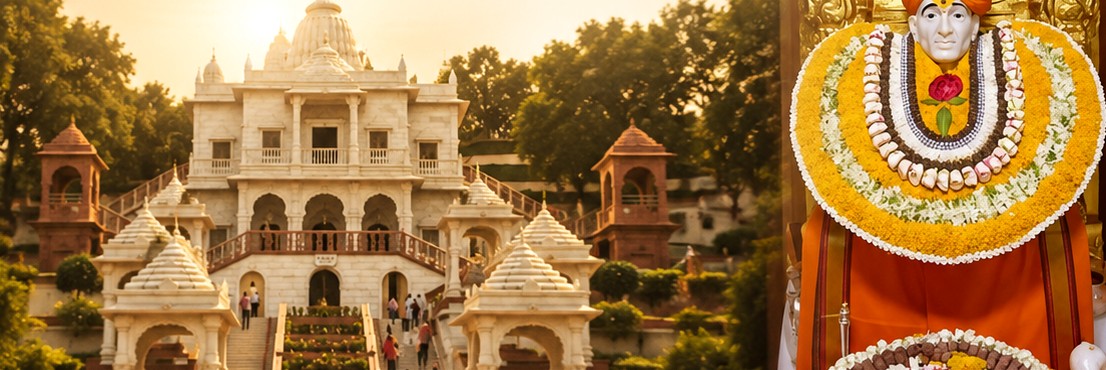
The Ashtavinayak Yatra is Maharashtra’s most beloved Ganesha pilgrimage — a circuit of eight shrines scattered across Pune, Ahmednagar and Raigad districts, where the presiding murtis are revered, according to tradition, as svayambhu, or self-manifested. The word itself means “eight Ganeshas,” and completing the round is considered a vow fulfilled rather than a mere sightseeing trip. Pilgrims traditionally begin and end at Morgaon, covering roughly 600 to 700 kilometres of driving over approximately one and a half to two days. This guide from our team at Gajanan Maharaj Sansthan — where Ganesha bhakti shapes our daily seva in Omkareshwar — walks you through the order, the distances, the seasons and the practical decisions, so your yatra flows as smoothly as a well-sung aarti.
Why the Ashtavinayak Yatra Matters
Each of the eight shrines enshrines a distinct form of Ganesha with its own name, legend and personality — the peacock-riding Mayureshwar, the boon-giving Varadavinayak, the worry-removing Chintamani, the cave-dwelling Girijatmaj among them. According to tradition, the murtis at these temples were not sculpted and installed by human hands but manifested on their own, which gives the circuit its special sanctity. Devotees believe that undertaking the Ashtavinayak Yatra with sincerity removes obstacles, settles restless minds and fulfils heartfelt wishes — which is why families return generation after generation, often on the occasion of a wedding, a new home or the start of a child’s education.
The yatra is also a lovely portrait of rural Maharashtra: riverbanks at Siddhatek and Ozar, the Mula-Mutha confluence at Theur, the fortified hill country of Junnar and the Konkan-edge valleys near Pali. You are never just driving between temples; you are driving through the sage-stories of the land.
The Eight Shrines at a Glance
| Order | Temple & Deity | District | Approx. road distance from Pune |
|---|---|---|---|
| 1 (and 9) | Morgaon — Mayureshwar (Moreshwar) | Pune | 65–75 km |
| 2 | Siddhatek — Siddhivinayak | Ahmednagar | 90–100 km |
| 3 | Pali — Ballaleshwar | Raigad | 110–120 km via Khopoli |
| 4 | Mahad — Varadavinayak | Raigad | 85–95 km |
| 5 | Theur — Chintamani | Pune | 25–30 km |
| 6 | Lenyadri — Girijatmaj | Pune (Junnar taluka) | 90–100 km |
| 7 | Ozar — Vighneshwar | Pune (Junnar taluka) | 85–95 km |
| 8 | Ranjangaon — Mahaganapati | Pune (Shirur side) | 50–55 km |
All distances are approximate and depend on your starting point in Pune and the exact roads taken; traffic around Pune and on the Khopoli stretch can stretch travel times considerably on weekends.
The Traditional Order: Morgaon First, Morgaon Last
The classic sequence is Morgaon → Siddhatek → Pali → Mahad → Theur → Lenyadri → Ozar → Ranjangaon, followed by a return to Morgaon. The logic is both spiritual and geographical. Spiritually, Mayureshwar at Morgaon is regarded as the adhyapak — the presiding teacher — of the eight, so the yatra opens and closes at his door. Geographically, the loop naturally sweeps east to the Bhima river, south into Raigad, back past Pune’s doorstep, and north to the Junnar hills before descending home.
On a typical two-day plan, Day 1 covers Morgaon, Siddhatek, Pali and Mahad with a night halt around Pali, Mahad or Khopoli. Day 2 rises early for Chintamani darshan at Theur, climbs to the cave shrine of Girijatmaj at Lenyadri, bows to Vighneshwar at Ozar and closes with Mahaganapati at Ranjangaon before the return darshan at Morgaon on the way into Pune.
| Day | Suggested route | Approx. driving |
|---|---|---|
| Day 1 | Pune → Morgaon → Siddhatek → Pali → Mahad (halt) | 280–320 km |
| Day 2 | Mahad → Theur → Lenyadri → Ozar → Ranjangaon → Morgaon → Pune | 300–340 km |
Treat these as indicative figures; with darshan queues, meals and the Lenyadri climb, Day 2 is a full day, so start by dawn.
Best Season for the Yatra
October to February is the sweet spot — clear skies, cool mornings for the roughly 280 to 300-plus steps at Lenyadri and pleasant driving throughout. March and May are hot but manageable if you travel early and rest at midday. The monsoon, from roughly June to September, turns the Sahyadri stretches green and beautiful, but rural roads near Pali and Siddhatek can flood or develop potholes, and the Lenyadri steps become slippery. Festival crowds peak on Ganesh Chaturthi, Sankashti Chaturthi (especially Angaraki Sankashti) and long weekends — rewarding for their energy, demanding for their queues.
Taxi, Self-Drive and Budget Notes
Most pilgrims hire a cab for the full circuit. Indicatively, a two-day Ashtavinayak package from Pune costs approximately INR 12,000 to 18,000 for a sedan-sized vehicle depending on season, operator and inclusions — confirm the exact fare, tolls and driver charges at booking. Self-driving is equally popular: fuel for the roughly 600 to 700 km loop, tolls and an overnight stay typically come to approximately INR 6,000 to 10,000 for two people, again to be verified at booking. Accommodation ranges from simple lodges at Pali, Mahad and Narayangaon (approximately INR 800 to 2,500 per night) to comfortable hotels in Pune — confirm current rates and availability when you reserve.
A few practical tips from yatris:
- Carry cash in small notes for village parking, prasad and tea stalls; digital payment works in many places but not all.
- Keep Wednesdays and Sankashti days in mind — Ganesha temples draw heavier crowds on these days.
- Pack light but smart — walking shoes for Lenyadri, a light scarf for the sun, and water for the stretches between shrines.
- Confirm darshan timings at each temple with local authorities before finalising your schedule, as timings change with seasons and festival days.
Pairing the Yatra with Other Maharashtrian Tirthas
The circuit sits inside a wider web of Maharashtra’s sacred geography. Many pilgrims extend the journey into the Shirdi–Pandharpur–Shegaon circuit, adding Sai Baba’s darshan, Vitthal’s Chandrabhaga and Gajanan Maharaj’s Samadhi Mandir at Shegaon — a natural continuation of the same devotional thread that brings travellers to our own doors in Omkareshwar. Others branch to Jejuri’s Khandoba temple beside Morgaon, or to Bhimashankar’s Jyotirlinga in the same hills as the Junnar caves. However you extend it, build rest days: a yatra done breathlessly is a route covered, not a pilgrimage felt.
Summary
The Ashtavinayak Yatra is best planned from Pune over approximately one and a half to two days by car, following the traditional order of Morgaon, Siddhatek, Pali, Mahad, Theur, Lenyadri, Ozar and Ranjangaon, with a return darshan at Morgaon to seal the circuit. Travel between October and February, budget approximately INR 12,000 to 18,000 for a hired two-day taxi or modestly less if self-driving, and confirm temple timings and room rates at booking. Done at an unhurried pace, the eight darshans leave you with what Ganesha’s bhaktas have always sought — a mind clearer of obstacles and a heart fuller of shanti.
Frequently Asked Questions
How many days are needed for the Ashtavinayak Yatra?
Most pilgrims complete the eight temples in approximately one and a half to two days by car from Pune, with an overnight halt around Pali, Mahad or Junnar. A relaxed three-day plan is gentler if you wish to add aartis, and the circuit can also be stretched across several weekends.
What is the correct order of the Ashtavinayak temples?
The traditional sequence is Morgaon, Siddhatek, Pali, Mahad, Theur, Lenyadri, Ozar and Ranjangaon, followed by a return darshan at Morgaon to complete the yatra. The first and last shrine is Mayureshwar at Morgaon, the principal seat of the circuit.
Can the Ashtavinayak Yatra be done by public transport?
It is possible using a mix of MSRTC buses and shared jeeps to towns such as Jejuri, Daund, Khopoli and Narayangaon, but connections are slow and some shrines sit a few kilometres off the main roads. A hired taxi or self-drive car is the practical choice for most pilgrims.
When is the best time to do the Ashtavinayak Yatra?
October to February offers cooler weather for the climb at Lenyadri and comfortable road travel. Avoid peak monsoon weeks when rural stretches flood, and expect heavy crowds on Ganesh Chaturthi, Sankashti Chaturthi and festival weekends.