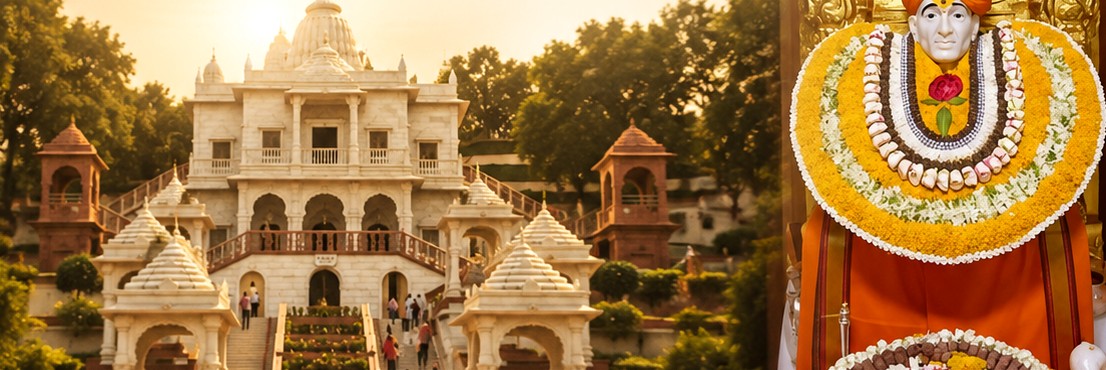
The Trimbakeshwar Jyotirlinga, set in the quiet temple town of Trimbak in Maharashtra’s Nashik district, is one of the most distinctive stops on any Jyotirlinga pilgrimage. While every one of the twelve shrines holds its own grace, Trimbakeshwar combines three rare blessings in one place: a linga that tradition says embodies the Trimurti itself, the source of the Godavari river on the hill directly above, and the living seat of some of India’s most respected Vedic rituals. This complete darshan guide covers everything a first-time pilgrim needs — the legend, the architecture, the darshan experience, and the best time to visit.
One of the Twelve Jyotirlingas
Trimbakeshwar holds its place in the traditional recitation of the Dwadash Jyotirlinga, appearing eighth in the list most commonly followed across India. It is one of the five Jyotirlingas located in Maharashtra, which makes the state — along with its saints’ traditions that devotees of Gajanan Maharaj know so well — an especially rich destination for Shaiva pilgrims.
For the full sacred geography, see our article on the 12 Jyotirlingas of India and their locations. Many pilgrims plan multi-shrine journeys — for instance, pairing Trimbakeshwar with Bhimashankar and Grishneshwar in Maharashtra, or journeying onward to Omkareshwar and Mahakaleshwar in Madhya Pradesh, where our own Sansthan serves pilgrims on the banks of the Narmada.
According to tradition, the Jyotirlinga here manifested at the foot of Brahmagiri hill, where the Godavari — the “Ganga of the South” — is believed to have been brought down to earth through the penance of the sage Gautama. The story links the sage, the hill, the river and the linga into a single sacred narrative that devotees still recite today.
The Three-Faced Linga
What draws pilgrims from across India is the sanctum itself. The Trimbakeshwar linga is unlike any other among the twelve. According to tradition, the stone carries three faces embodying the Trimurti — Brahma the creator, Vishnu the preserver, and Mahesh (Shiva) the destroyer — set within a natural depression or hollow in the rock. Devotees offer their prayers to this unusual form of the divine unity of the three great cosmic functions.
The linga is adorned with a crown of gold and precious ornaments, placed over the hollow — a sight of great devotional significance. Because of the sensitive nature of the ornamented sanctum, darshan inside the garbhagriha is brief and closely guided by temple staff; pilgrims should expect a few moments of direct viewing rather than a long stay inside. Photography is strictly prohibited within the sanctum, and visitors are asked to keep the flow moving so everyone receives darshan.
Temple Architecture and Atmosphere
The present Trimbakeshwar temple is a striking black stone structure, traditionally attributed to the Peshwa era of the eighteenth century. It is regarded as a fine example of Hemadpanti-style architecture, a building tradition associated with the medieval period in this region, though the structure pilgrims see today reflects later patronage and restoration.
Several features stand out:
- The black stone walls and shikhara, which give the temple a solemn, grounded presence distinct from the lighter marble shrines elsewhere in India.
- The large courtyard and sabha mandap, where queues are organised and pilgrims wait amid carved pillars.
- The Kushavarta tirtha just outside the temple — the sacred bathing kund where millions gather during the Kumbh — where pilgrims traditionally bathe before darshan.
- The hills that surround the town, enclosing Trimbak in a bowl of forested slopes that makes the whole settlement feel removed from ordinary time.
The town itself is small and oriented almost entirely toward the temple: lanes of puja shops, prasad stalls, and the homes of the local priest families who have served the rituals here for generations.
Darshan Flow: What to Expect
A typical visit moves through a familiar rhythm, though arrangements evolve, so always confirm details with temple authorities as schedules change.
| Stage | What Happens | Approx. Guidance |
|---|---|---|
| Bathing at Kushavarta | Ritual bath at the kund before darshan | 30–45 minutes |
| Queue entry | Free general queue; paid express passes have been offered in some seasons | 30 minutes–3 hours depending on crowd |
| Sanctum darshan | Brief viewing of the three-faced, crowned linga | A few moments per group |
| Optional seva | Rudrabhishek and other pujas booked at the temple office | 1–2 hours |
| Brahmagiri climb | Steps up to Gangadwar, the Godavari’s source | 2–3 hours round trip |
Full details of opening hours, aarti times and queue options are covered in our Trimbakeshwar darshan timings guide. As a broad rule, the temple opens in the early morning — approximately 5:30 AM — closes for an afternoon break, and reopens until approximately 9:00 PM, but exact timings vary by season and festival calendar.
Trimbakeshwar is also the traditional seat of the renowned Narayan Nagbali, Kalsarp and Tripindi Shraddh rituals, performed by hereditary local priest families. Pilgrims travelling specifically for these pujas usually arrive a day early and book in advance through established channels.
The Godavari Connection
No visit to Trimbakeshwar is complete without acknowledging the river that defines it. The Godavari, honoured as Dakshin Ganga, is believed to originate at Gangadwar on Brahmagiri hill, directly above the temple. A flight of stone steps — commonly said to number somewhere between roughly 500 and 750, depending on the route and how they are counted — leads pilgrims up to the small shrine at the source.
The full story of the river’s origin and the climb to Gangadwar is explored in our article on Gangadwar, Brahmagiri and the source of the Godavari. For pilgrims familiar with Omkareshwar, there is a pleasing symmetry: one Jyotirlinga where the Narmada circles the shrine, and another where the Godavari is born above it.
Best Time to Visit
The most pleasant months are roughly October to March, when the Deccan plateau cools and the climb to Brahmagiri is comfortable. Shravan Mondays and Mahashivratri draw enormous crowds — deeply rewarding for devotees who wish to be part of the intensity, but demanding for families with elderly members or small children. The monsoon, approximately June to September, turns the hills vivid green and swells the Godavari, though the step climb can be slippery. Summer, from late March to May, is hot, and pilgrims should plan early-morning darshan and carry water.
Summary
The Trimbakeshwar Jyotirlinga offers one of the most complete pilgrimage experiences in Maharashtra: a crowned, three-faced linga unique among the twelve Jyotirlingas; a majestic black stone temple in the Hemadpanti tradition; the sacred Kushavarta kund; the birthplace of the Godavari on Brahmagiri above; and the quiet dignity of a town devoted wholly to Shiva. Plan around 5:30 AM darshan or an early start, allow a full day if you wish to climb to Gangadwar, and confirm timings and seva bookings with temple authorities in advance. Visited with patience and reverence, Trimbakeshwar leaves a lasting impression — a shrine where the Trimurti, the river and the hills seem to meet in a single breath of devotion.
Frequently Asked Questions
What makes the Trimbakeshwar linga unique among the 12 Jyotirlingas?
According to tradition, the Trimbakeshwar linga embodies the Trimurti — Brahma, Vishnu and Mahesh — represented through three faces set within a hollow in the stone. It is also adorned with a crown of precious ornaments, which is unusual among Jyotirlinga shrines.
How far is Trimbakeshwar from Nashik?
Trimbakeshwar lies approximately 30 km from Nashik city, a drive of roughly 45 minutes to an hour depending on traffic. Buses and taxis connect the two throughout the day.
Can we combine Trimbakeshwar with the Godavari origin at Brahmagiri?
Yes. The source of the Godavari at Gangadwar on Brahmagiri hill sits directly above the temple. Pilgrims commonly climb the stone steps after darshan, keeping approximately two to three hours for the round trip.