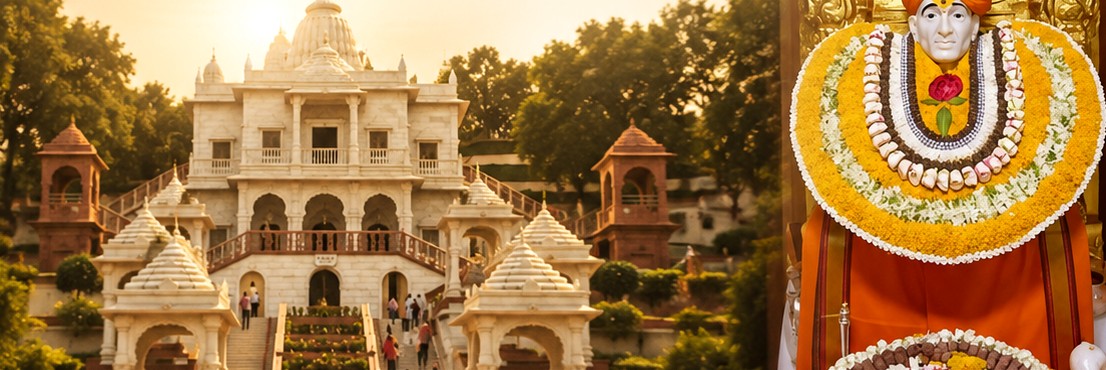
Rivers in India are not merely water; they are presence. And among all the sacred rivers of the Deccan, none carries the prestige of the Godavari — honoured as Dakshin Ganga, the Ganga of the South. Her birthplace is not a distant glacier but a small, shrine-crowned hollow on Brahmagiri hill, directly above the Trimbakeshwar Jyotirlinga temple. Pilgrims who make the stone-step climb to Gangadwar stand, quite literally, at the source of a river that flows nearly 1,500 kilometres across the peninsula to the Bay of Bengal. This is the story of that source — its legend, its ritual meaning, and the practical experience of the climb.
The Godavari: Dakshin Ganga
The Godavari is the second-longest river of India and the great arterial river of the Deccan. Over her course she waters Maharashtra, Telangana, Andhra Pradesh and beyond, touching sacred geographies such as the temple towns of the downstream Godavari belt. Her traditional stature, however, comes from her association with the Ganga herself: the epithet Dakshin Ganga signals the belief that to bathe in the Godavari is, in merit, to bathe in the Ganga.
The naming is tied to the founding legend. According to tradition, the land of the Deccan had long been without a sacred river. The sage Gautama, through long austerities on Brahmagiri, is said to have pleased Lord Shiva; at his devotion’s fruit, waters of the Ganga were granted to the South. Tradition further relates that the river was held back for a time — the word godaa (to drink, in a vernacular sense) is popularly linked to her name — before she was released to flow. Variants of the legend differ in detail, as legends do, but all agree on the essentials: a sage’s tapasya, Shiva’s grace, Ganga’s descent, and a hill in Trimbak as the meeting point of them all.
Brahmagiri Hill and Gangadwar
Brahmagiri — the “hill of Brahma” — rises immediately behind the Trimbakeshwar temple. At its summit, at the point identified as the Godavari Udgam Sthal (place of origin), stands the small shrine of Gangadwar, the “gate of the Ganga,” marking the spot where the river is believed to first surface. A modest temple structure encloses the spring; small stone tanks gather the first waters, and priests at the shrine offer the river’s first darshan to pilgrims.
Below the summit, on the slopes and at the base of the hill, the tradition continues: the waters that seep from Brahmagiri gather at the Kushavarta tirtha beside the main temple — the great bathing kund where pilgrims by the thousands perform their ritual baths, and where the Kumbh Mela’s royal baths take place. Thus the pilgrimage architecture of Trimbak reads as a single sentence: the hill, the source, the gathering kund, and the Jyotirlinga, each element consecrating the next. An orientation to the temple itself is in our Trimbakeshwar Jyotirlinga guide.
The Climb: What to Expect
The path to Gangadwar is a flight of ancient stone steps cut into the forested hillside. Pilgrims commonly describe the count as falling somewhere between roughly 500 and 750 steps depending on the route followed and where counting begins — the honest answer is “several hundred,” and the wiser preparation is pace, not arithmetic.
| Aspect | Guidance |
|---|---|
| Ascent time | Approximately 45–90 minutes each way for most visitors |
| Difficulty | Moderate; steady steps but continuous ascent; rest ledges along the way |
| Best hours | Early morning; avoid midday heat, and exercise care in monsoon |
| Footwear | Sturdy shoes; steps may be worn, uneven or slippery |
| Facilities | Basic; carry water; small stalls near the base only |
| Who should plan carefully | Elderly pilgrims, those with knee or heart conditions — climb slowly or seek blessings at Kushavarta instead |
The climb itself is part of the offering. Tradition holds that the effort of the ascent, made with the name of the river on one’s lips, bears its own merit. Pilgrims recite the Godavari’s name, sing bhajans, and pause at the rest points where the Trimbak valley opens below — the temple’s black shikhara appearing small amid the town’s rooftops. At the summit, the mood changes: quiet, cool, the murmur of the first waters, and the Gangadwar shrine waiting.
Many pilgrims carry a small vessel to fill at the source; it is customary to offer what you take and leave the place as undisturbed as you found it.
Ritual Significance of the Source
For Hindus, a river’s udgam sthal — its place of origin — carries exceptional purity, and rituals performed at a source are believed to be especially efficacious. At Gangadwar and Kushavarta, pilgrims perform:
- Snan (ritual bath) — at the source tanks above, or at Kushavarta below.
- Pinda-dan and shraddh — offerings to ancestors, for which the Godavari’s banks are renowned; the great ancestral vidhis of Trimbakeshwar open with a bath here.
- Tarpan and dana — water oblations and charitable offerings in the river’s name.
It is this confluence of river-sanctity and Jyotirlinga grace that made Trimbakeshwar the traditional seat of the region’s weightiest rituals.
Godavari and Narmada: Two Sacred Sisters
Devotees who revere one great river often find their devotion deepened by another. The Godavari and the Narmada — the river that encircles the Omkareshwar Jyotirlinga, where our Sansthan serves pilgrims — are the two great sacred sisters of the Deccan and central India, and their sources present a moving contrast. The Narmada, too, is believed to emerge from a sacred hill — Amarkantak, the Amarkantak source being described in our Narmada Udgam guide. The Godavari is born above a Jyotirlinga; the Narmada flows around one. Both rivers are held to be so pure that, by tradition, their mere remembrance confers merit — a reflection explored in our essay on the significance of the Narmada (Reva) river.
Summary
Gangadwar on Brahmagiri hill is the traditional source of the Godavari — the Dakshin Ganga — born, according to tradition, through the austerities of sage Gautama and the grace of Shiva, directly above the three-faced Trimbakeshwar Jyotirlinga. The climb of several hundred stone steps (commonly described as roughly 500–750) is a moderate, deeply rewarding pilgrimage through forested slopes to a quiet hilltop shrine, best begun early in the morning. Together with the Kushavarta kund below, the source completes one of India’s most concentrated sacred landscapes — a place where a river is born, gathers, and greets the Lord, all within a single hill’s embrace. Confirm local conditions before your climb, carry little, and let the first waters of the Godavari do what sacred rivers have always done: carry the pilgrim’s prayers downstream.
Frequently Asked Questions
Where does the Godavari river originate?
According to tradition and the belief held at Trimbakeshwar, the Godavari originates at Gangadwar on Brahmagiri hill, directly above the Trimbakeshwar Jyotirlinga temple. The waters first surface at the hilltop and gather at the Kushavarta kund at the base.
How many steps are there to Gangadwar on Brahmagiri?
The stone step path to Gangadwar is commonly described as numbering somewhere between roughly 500 and 750 steps, depending on the route and counting. The climb typically takes 45 to 90 minutes each way for most visitors, at a steady pace with rest stops.
Why is the Godavari called Dakshin Ganga?
The Godavari is honoured as Dakshin Ganga — the Ganga of the South — because, according to tradition, her waters carry the sanctity of the Ganga, brought to the Deccan through the penance of the sage Gautama at Brahmagiri.