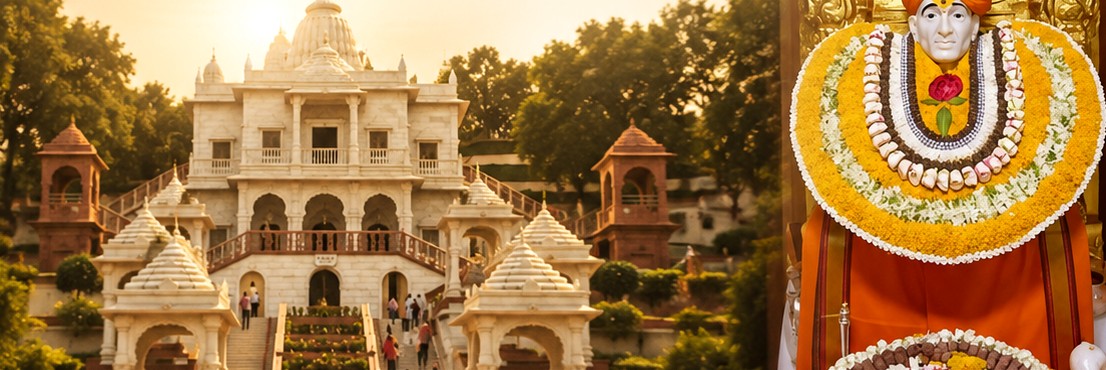
Tucked against the bank of the Bhima river in Karjat taluka of Ahmednagar district, the Siddhivinayak Temple at Siddhatek is the quiet hermit among the eight Ashtavinayak shrines of Maharashtra. It is the second stop on the traditional yatra after Morgaon, yet it feels a world away from anywhere — a small village, a river sliding past, and a Ganesha whose very name means “bestower of siddhi,” of accomplishment. For pilgrims used to the crowds of the city temples, Siddhatek offers the rarest luxury of the Ashtavinayak circuit: the space to stand still. Our seva team at Gajanan Maharaj Sansthan, Omkareshwar, has a soft spot for riverbank shrines — our own temple town lives on an island of the Narmada — and this guide shares everything a first-time visitor needs.
Siddhatek and the Bhima
The village of Siddhatek lies where the Bhima river runs broad and unhurried through eastern Maharashtra’s farmland, and the temple rises on the northern bank within a small stone precinct. The setting is the shrine’s great teacher: priests and villagers alike will tell you that sitting a while by the river after darshan is part of the visit, not an optional extra. The temple itself is compact, with a sanctum housing the swayambhu murti and a veranda from which you can hear the river birds.
Because Siddhatek is reached via rural roads rather than a highway, the journey here is slower than the kilometres suggest — approximately 90 to 100 kilometres from Pune via the Shirur or Daund side, typically two and a half to three hours of driving. Come with time in hand; this is not a shrine to be checked off between appointments.
The Legend: Vishnu’s Invocation at Siddhatek
According to tradition, woven through the Ganesha Purana and Mudgala Purana lore of the Ashtavinayak cycle, it was here on the Bhima’s bank that Lord Vishnu, locked in battle with the demons Madhu and Kaitabha, paused to invoke Ganesha before striking the decisive blow. Pleased by the invocation, Ganesha is said to have granted Vishnu siddhi — the power of assured success — from which the deity and the village both take the name Siddhivinayak, and the hillock the name Siddhatek, the “seat of siddhi.”
Tradition further recounts that Brahma, the creator, performed penance at this spot and consecrated his worship of Ganesha here, cementing the shrine’s reputation among the eight. The murti itself is revered as swayambhu — self-manifested — and is especially noted, according to tradition, for its trunk turned towards the right, a form regarded as rare and potent. Devotees with a specific mannath, or heart’s request, traditionally choose Siddhatek for their prayers.
Darshan at the Riverbank Shrine
| Quick fact | Detail (approximate/indicative) |
|---|---|
| Location | Siddhatek village, Karjat taluka, Ahmednagar district |
| Distance from Pune | 90–100 km via Shirur/Daund, 2.5–3 hours |
| Setting | North bank of the Bhima river |
| Nearest railhead | Daund, roughly 30–40 km away |
| Ideal time | Morning darshan, then a quiet half-hour by the river |
The temple generally opens around dawn and closes by evening, with abhishek and aarti through the morning; festival days such as Sankashti Chaturthi and Ganesh Chaturthi bring village-scale crowds and longer queues. As everywhere, timings shift with season and occasion, so confirm with temple authorities before planning your day. Facilities are modest — a few stalls for prasad and simple food, basic parking — which is precisely why pilgrims describe Siddhatek as the most peaceful darshan of the eight.
Etiquette is straightforward: dress modestly, leave footwear at the designated stands, avoid photography inside the sanctum, and if you perform abhishek, book it through the temple office and carry your receipt.
Reaching Siddhatek: Route Notes
From Pune, the two common approaches are via Shirur on the Pune–Ahmednagar road and then country roads south towards the Bhima, or via Daund on the southern rail corridor. Both are scenic and both slow down in the final kilometres. Self-drive and hired taxis are the practical options; a day’s taxi from Pune covering Mahaganapati at Ranjangaon and Siddhatek together costs indicatively INR 4,000 to 6,000 — confirm at booking. By train, Daund station is the nearest railhead, roughly 30 to 40 kilometres away by road, with taxis and shared vehicles available.
Within the traditional circuit, Siddhatek is usually the second darshan of day one. From here the classical route bends south and west towards Pali and Mahad in Raigad district — a long but lovely cross-country drive through the Sahyadri’s lower valleys. Our complete Ashtavinayak Yatra guide lays out the day-wise plan with hedged distances, and the Raigad pair — Ballaleshwar at Pali and Varadavinayak at Mahad — makes a natural second half of the journey.
Planning Tips from Fellow Yatris
- Fuel and food first. Fill the tank and eat before leaving the highway side; options near Siddhatek are basic and irregular.
- River safety. The Bhima looks calm but has sudden depths; bathe only where locals advise, and supervise children on the bank.
- Combine thoughtfully. Siddhatek plus Ranjangaon makes a balanced day loop from Pune; adding Morgaon makes a full but satisfying triangle.
- Go early. Rural roads are best navigated in daylight, and the morning light on the river is the finest darshan bonus Siddhatek offers.
Summary
Siddhatek’s Siddhivinayak is the Ashtavinayak of accomplishment — the shrine where, according to tradition, Vishnu himself invoked Ganesha before victory, on the serene bank of the Bhima river. Reach it from Pune via Shirur or Daund over approximately 90 to 100 kilometres, allow a relaxed half-day, and pair it with Ranjangaon on a loop or Pali and Mahad on the full circuit. Few shrines reward unhurried devotion as generously; come with a request or simply with gratitude, and leave with the river’s quiet still echoing.
Frequently Asked Questions
Why is Siddhatek called the remotest Ashtavinayak?
Siddhatek sits on the bank of the Bhima river in a quiet corner of Ahmednagar district, reached via rural roads from the Shirur or Daund side rather than a main highway. Compared with Theur or Ranjangaon near Pune, it feels far more off the beaten track, though the drive from Pune is only about 90 to 100 kilometres.
What is the significance of the Siddhatek murti?
According to tradition, the swayambhu murti of Siddhivinayak is notable for its trunk turned towards the right, a form considered rare and spiritually potent. Devotees believe Siddhivinayak grants siddhi — accomplishment and fulfilment — to sincere seekers.
How do I reach Siddhatek from Pune?
Drive approximately 90 to 100 kilometres from Pune via the Shirur or Daund side, allowing roughly two and a half to three hours including rural stretches. The nearest railhead is Daund, from where taxis and shared vehicles can be arranged.
Which temples can be combined with Siddhatek?
Ranjangaon's Mahaganapati lies broadly on the Pune–Ahmednagar corridor and pairs well with Siddhatek on a day loop. Pilgrims doing the full circuit typically visit Siddhatek on day one before heading south towards Pali and Mahad.