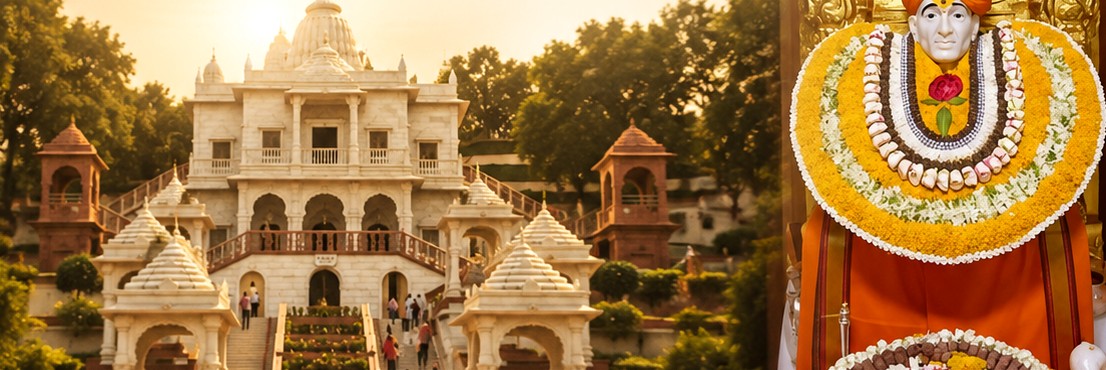
On the busy Pune–Ahmednagar road near Shirur, roughly 50 to 55 kilometres from Pune, stands the shrine that tradition calls the seat of Ganesha’s most majestic form. Mahaganapati of Ranjangaon is the eighth shrine of the Ashtavinayak Yatra — the last new darshan before the pilgrim circles back to Morgaon — and the deity here is honoured as the “Maha” form, the great Ganapati invoked by no less than Shiva himself before battle. For Pune residents, it is also simply the easiest of the eight to visit: under an hour and a half’s drive, generous parking, a grand temple complex. Our team at Gajanan Maharaj Sansthan, Omkareshwar, offers this guide to Ranjangaon’s legend, darshan flow and day-trip planning.
The Invoked Ganesha: Shiva Before Tripurasura
According to tradition, the demon Tripurasura built three impregnable flying cities and unleashed chaos on the worlds, and the gods turned to Shiva for deliverance. Before setting out, Shiva is said to have halted at Ranjangaon and invoked Ganesha — the deity who must always be honoured first — and with the Lord’s grace, his campaign succeeded. Devotees trace to this very story the custom, universal across Hindu life, of saluting Ganesha before any undertaking: the first invocation, achyuta-kripa before action, adoration before ambition.
The shrine’s presiding deity is therefore revered as Mahaganapati, the great and powerful form, and pilgrims with weighty undertakings — litigation, business launches, difficult transitions — are especially drawn here. The tradition further holds that the swayambhu murti manifests Ganesha in a form of immense potency; standing before the sanctum, few devotees dispute the feeling.
The Temple and Its Scale
| Quick fact | Detail (approximate/indicative) |
|---|---|
| Location | Ranjangaon, Shirur side, Pune district |
| Distance from Pune | 50–55 km on the Pune–Ahmednagar road, 1–1.5 hours |
| Yatra position | 8th of 8, before the return to Morgaon |
| Famous for | Mahaganapati, the invoked ‘Maha’ form |
| Crowd peaks | Wednesdays, Sankashti Chaturthi, Ganesh Chaturthi |
Among the eight, Ranjangaon’s temple is one of the largest complexes — a broad walled precinct with a substantial shikhara over the east-facing sanctum, spacious courtyards, and facilities built for the enormous festival crowds the shrine draws. The present structure shows layered construction across centuries, with portions attributed to the Peshwa era in local accounts — a hedge every honest guide should offer, since temple chronologies are quilted from patronage records and tradition. On ordinary weekdays the darshan moves quickly; on Angaraki Sankashti, the queue can swallow hours, and the temple grounds take on the energy of a fair.
Darshan Timings and Aarti
The temple generally opens around dawn, with kakada aarti, abhishek, maha-naivedya and evening shejaarti marking the day’s rhythm; timings shift across seasons and festival calendars, so confirm with temple authorities when planning. Abhishek bookings can usually be arranged through the temple office for an indicative fee of a few hundred rupees, subject to change — verify current rates on arrival. As at all these shrines: modest dress, footwear at the stands, no photography inside the sanctum, and a little patience on Chaturthi days.
The Easiest Day Trip from Pune
Ranjangaon’s accessibility is its quiet superpower. From Pune, the drive along the Pune–Ahmednagar highway (NH-60 corridor side) takes approximately one to one and a half hours depending on where in the city you start and the highway’s mood. MSRTC buses towards Shirur and Ahmednagar stop within reach of the temple, and a hired taxi for the day runs indicatively INR 3,500 to 5,000 — confirm at booking. Many Pune families make Ranjangaon their introduction to the Ashtavinayak circuit: one comfortable morning out, one grand darshan, home by lunch.
Two satisfying day loops from Pune:
- The eastern pair: Ranjangaon plus Siddhivinayak at Siddhatek — approximately 90 to 100 kilometres to the riverbank shrine and back — a full but rewarding day through Daund-side countryside.
- The gentle sampler: Ranjangaon plus Chintamani at Theur, combining the circuit’s grandest and gentlest shrines in a relaxed loop of roughly 90 to 120 kilometres total.
On the traditional yatra, Ranjangaon is the finale: after Ozar, pilgrims drive down from Junnar, offer the eighth darshan here, and then turn south-west to Morgaon for the sealing darshan — a sequence our Ashtavinayak Yatra circuit guide maps in full.
Tips from Regular Pilgrims
- Beat the highway traffic — leave Pune by 7 AM for the smoothest run and the calmest sanctum.
- Weekday mornings are golden — you may get several unhurried minutes before Mahaganapati.
- Plan food around Shirur or the temple stalls — simple thalis, quick service.
- Keep Sankashti dates in mind — the temple’s festival energy is spectacular, but budget half a day.
- Tank up in Pune — fuel stations thin out on the rural stretches towards Siddhatek if you extend.
Summary
Mahaganapati at Ranjangaon is the invoked Ashtavinayak — the shrine where, according to tradition, Shiva honoured Ganesha before his campaign against Tripurasura, and where devotees still come before their own great undertakings. At approximately 50 to 55 kilometres from Pune on the Ahmednagar road, it is the circuit’s easiest day trip, best paired with Siddhatek or Theur, and on the full yatra it stands eighth and last before the return to Morgaon. Whether you come with a battle ahead or only gratitude behind, the great Ganapati of Ranjangaon receives both with equal majesty.
Frequently Asked Questions
Why is Mahaganapati at Ranjangaon called the invoked Ganesha?
According to tradition, Shiva himself worshipped and invoked Ganesha here before his campaign against the demon Tripurasura, which is why the shrine's deity is revered as Mahaganapati, the great form of Ganesha. The story is also cited as the origin of worshipping Ganesha before any major undertaking.
How far is Ranjangaon from Pune?
Ranjangaon lies approximately 50 to 55 kilometres from Pune on the Pune–Ahmednagar road near Shirur, about one to one and a half hours by car. It is the closest full-scale Ashtavinayak temple to Pune after Theur and the easiest day-trip of the eight.
What are the darshan timings at Ranjangaon temple?
The temple typically opens in the early morning and remains open until evening, with aarti and abhishek through the day. Crowds swell on Wednesdays and Sankashti Chaturthi — confirm current timings with temple authorities as schedules change.
Can Ranjangaon be combined with other temples?
Yes. It pairs naturally with Siddhivinayak at Siddhatek for an eastern loop from Pune, and on the full Ashtavinayak circuit it is the eighth and final temple before the traditional return darshan at Morgaon.