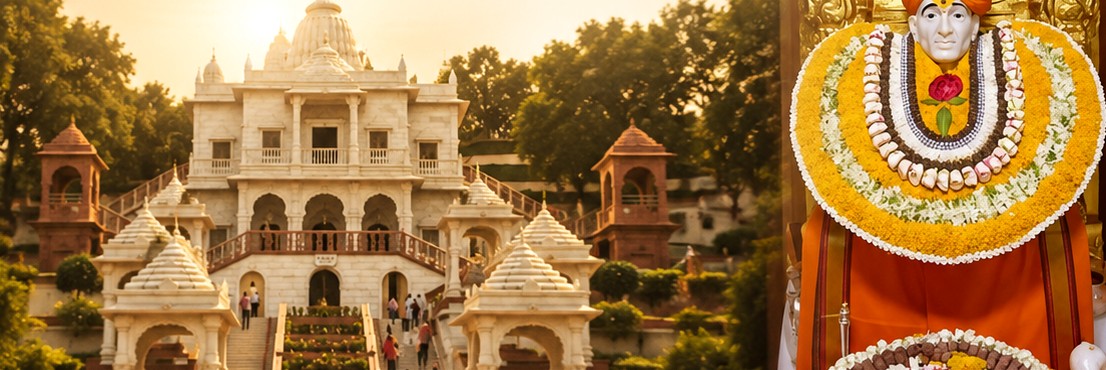
Among the great saints of Maharashtra, few voices travel as far today as that of the quiet fakir of Shirdi. The teachings of Sai Baba, preserved through the memories of his devotees and the hagiographies written after his passing in October 1918, are remarkable for their simplicity: have faith, be patient, feed the hungry, and see the same God in every place and every person. He left behind no books and, according to tradition, no personal possessions beyond a few cloths and a chillum — yet his words, transmitted orally by generations of devotees, continue to guide millions. This article explores the core of what Baba taught, always remembering that specific sayings come to us as attributed tradition rather than verbatim record.
Shraddha and Saburi: The Two Wings of Devotion
If Sai Baba’s teaching could be compressed into a single pair of words, most devotees would choose shraddha and saburi. Shraddha is often translated as faith, but it carries a warmer sense — loving trust, the confidence a child places in a parent. Saburi is patience or perseverance, the willingness to wait upon God’s timing without complaint.
According to tradition, Baba likened these two qualities to the wings with which a devotee crosses the ocean of worldly life. The pairing is deliberate and practical: faith without patience collapses at the first disappointment, while patience without faith is mere endurance. In an age of instant answers, this double teaching remains perhaps the most countercultural — and most needed — element of his message. Devotees visiting Shirdi often find that the long darshan queues themselves become an unexpected exercise in saburi.
Sabka Malik Ek: One Master for All
The phrase most closely associated with Sai Baba is “Sabka Malik Ek” — an Urdu expression meaning, roughly, “there is one Master, one God, for all.” It is attributed to Baba as a recurring refrain of his life in Shirdi, and it is said that he would point devotees back to this truth whether they approached him as Hindus, Muslims or Parsis.
The attribution matters. Because Baba left no writings, the exact wording of his sayings rests on the recollections of devotees recorded years later, and hagiographic tradition has inevitably shaped them. What is beyond dispute is the pattern of his life: he lived in a mosque, participated in Hindu festivals, recited from both the Quran and Hindu scriptures according to devotees’ accounts, and drew followers from every community. The saying, whether quoted exactly or remembered devotionally, distills that lived unity.
Shirdi in Baba’s time was a small village of mixed communities, and his daily life blurred every boundary that divided them. He lived in a mosque he called Dwarkamai, celebrated Hindu festivals such as Rama Navami and Holi alongside his neighbours, and is remembered to have arranged for both Hindu and Muslim rites to be observed in his presence. When he passed away in October 1918, according to records, his funeral rites themselves became a matter in which both communities participated.
This was not diplomacy but conviction. To the devotee who came with a tilak, Baba was a Hindu guru; to the one who came with a prayer cap, the same Baba was a Sufi-ish guide — yet his instruction, according to tradition, always pointed toward the one God beyond forms. In a world still fractured along religious lines, Shirdi remains one of the rare shrines where the same sanctum is reverenced by all communities side by side.
Seva and the Sacred Duty of Feeding
No element of Baba’s teaching was more visible than his care for the hungry. It is said that he would cook food in Dwarkamai in large handis and personally distribute it, insisting that no visitor leave Shirdi unfed. The famous line often attributed to him — that if you look upon all beings with equal love, you serve God — captures the spirit, though the exact wording again belongs to tradition.
That spirit endures institutionally. The Sai Sansthan operates large-scale prasad distribution and bhandaras, and devotees worldwide continue to sponsor annadaan, the gift of food, as the most natural expression of Baba’s memory. It is a tradition our own seva team recognises deeply: feeding pilgrims is also at the heart of our anna daan and bhandara seva at Omkareshwar, where the Narmada’s pilgrims are served in the same spirit.
Teaching by Living: Dwarkamai as Classroom
Baba’s method was rarely the sermon. He taught through the ordinary traffic of Dwarkamai — asking a devotee for dakshina to loosen attachment, sending another on an errand to heal a quarrel, lighting the dhuni each evening as a living emblem of the burning away of karma. The places themselves became the teaching: the masjid where a Muslim name sheltered a guru beloved of Hindus, the neem of Gurusthan, the garden he watered at dawn.
Pilgrims who walk these sites today generally find that the geography does what words cannot. Our guide to Dwarkamai, Chavdi and the other sacred places in Shirdi traces each location and the episode of Baba’s life it preserves, turning a temple visit into a walking meditation on his teachings.
A Parallel Saintly Tradition in Maharashtra
Sai Baba was not alone. Maharashtra’s spiritual soil produced, in the same era, Gajanan Maharaj of Shegaon, whose brief recorded life likewise emphasized feeding the hungry, silent contemplation and an utter indifference to worldly status. Devotees often place the two side by side as voices of one continuous bhakti stream that also remembers the varkari saints of Pandharpur. To explore that parallel tradition, read our account of Gajanan Maharaj’s teachings and legacy, which this Sansthan calls its own spiritual inheritance.
Living the Teachings Today
How does a modern devotee practise shraddha and saburi? The tradition itself suggests simple disciplines rather than elaborate rites, summarized below:
| Teaching | Core Meaning | A Simple Daily Practice |
|---|---|---|
| Shraddha | Loving trust in God and the guru | Begin the day with remembrance rather than the phone |
| Saburi | Patient perseverance on the path | When troubles come, hold on a day longer than seems reasonable |
| Sabka Malik Ek (attributed) | One God over all faiths | Speak of other faiths with the respect you wish for your own |
| Seva and annadaan | Service, above all feeding others | Feed someone — a guest, a stranger, a pilgrim — as worship |
In Shirdi, these ideals crystallize during the great festivals — particularly Guru Purnima, the day of the guru — when lakhs gather not for spectacle but to renew exactly this inner commitment. Our guide to Shirdi festivals explains how each observance embodies a facet of Baba’s message.
Summary
The teachings of Sai Baba of Shirdi reduce to a profound simplicity: shraddha — loving faith in the one God; saburi — patience that outlasts every trial; “Sabka Malik Ek” — the attributed motto affirming one Master for all faiths; and seva — above all, the feeding of the hungry. He wrote nothing, yet his remembered words and the pattern of his life in Dwarkamai continue to shape devotees of every religion a century after 1918. To read him is useful; to feed someone in his name, patiently and without distinction, is to understand him.
Frequently Asked Questions
What do shraddha and saburi mean in Sai Baba's teachings?
Shraddha means loving faith or trust in God and the guru, while saburi means patient perseverance on the spiritual path. Sai Baba, according to tradition, taught that these two qualities together carry a devotee safely through every difficulty of life.
What is the meaning of Sabka Malik Ek?
Sabka Malik Ek is an Urdu phrase attributed to Sai Baba meaning 'One God is the Master of all.' It is traditionally associated with his message that Hindu and Muslim devotees alike worship the same divine reality, and it remains a defining motto of Shirdi.
Did Sai Baba write any books of teachings?
No, Sai Baba left no writings of his own. His teachings survive through the recollections of devotees, oral tradition, hagiographies and later compilations, which is why specific sayings are best treated as attributed rather than verbatim.