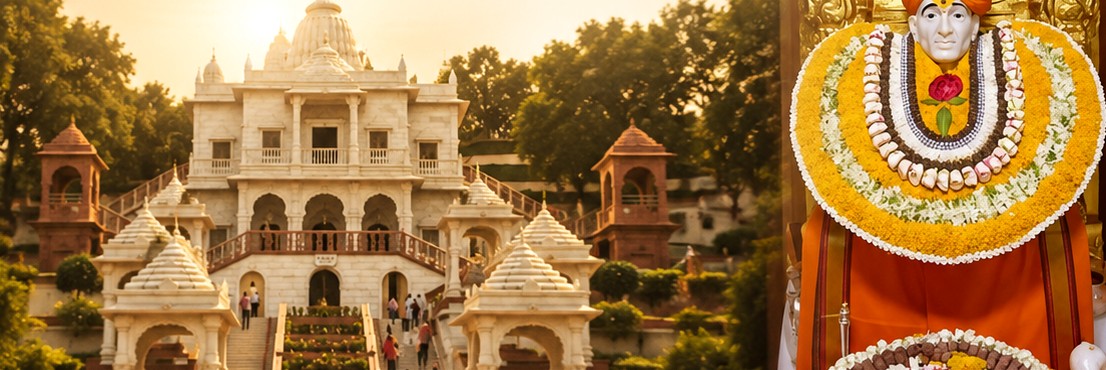
Most first-time visitors arrive in Shirdi thinking only of the Samadhi Mandir — and leave having discovered that Baba’s Shirdi is an entire landscape of memory. Dwarkamai in Shirdi, the worn little masjid where he lived; the Chavdi, where his nights alternated; Gurusthan beneath its neem tree; the quiet paths of Lendi Baug — each place preserves a chapter of the life that ended, according to records, in October 1918. This visitor’s guide walks you through every sacred spot, what it means according to tradition, and how to cover them all comfortably on foot.
Dwarkamai: The Masjid Where Baba Lived
Of all the sacred places in Shirdi, Dwarkamai is the most intimate. This simple, unadorned structure on the raised ground beside the Samadhi Mandir was an abandoned mosque when Baba made it his home, and he lived within its humble walls for decades, sitting on a piece of sackcloth, receiving the stream of devotees who came to him. The name is Baba’s own affectionate rendering — “Dwarka”, the beloved city of Krishna, attached to “Mai”, mother — a signal, devotees say, of the shelter he found there.
Two features draw every pilgrim’s attention. The first is the dhuni, the sacred fire that Baba is said to have kept burning continuously and which the Sansthan maintains to this day; the ash from it, known as udi, is distributed as prasad and revered by devotees for its healing associations. The second is the Nimbar, the western niche oriented toward Mecca, beside which Baba is said to have sat. Entering Dwarkamai, with its low ceilings and smoke-darkened walls, most pilgrims feel the presence of the fakir more vividly than anywhere else in Shirdi. It is here that the ordinary rhythms of his teaching played out — the cooking of food, the giving of udi, the endless patience with which he heard every visitor’s troubles.
Chavdi: The Place of Baba’s Nights
A short walk from Dwarkamai stands the Chavdi, a small building that served in Baba’s time as the village’s meeting and rest house. According to tradition, in his later years Baba slept alternately in Dwarkamai and the Chavdi, and every alternate night he was escorted between the two in a small procession of devotees carrying lamps, flags and music — a ceremony fondly remembered as the origin of today’s palanquin (palkhi) procession.
That procession survives. On Thursday nights, and on festival occasions, the Sansthan carries Baba’s portrait and padukas from Dwarkamai to the Chavdi with full honours — drums, lamps and singing — and it is among the most atmospheric moments a visitor can witness in Shirdi. Inside the Chavdi, the spot where Baba is traditionally said to have rested, along with a small stool and a white chair associated with him, remains the focus of devotion.
Gurusthan: Where It Began
Gurusthan — “the place of the guru” — marks the spot where, according to tradition, a young Baba was first seen seated in meditation under a neem tree when he arrived in Shirdi as a boy. It was here that Baba later indicated his own guru’s presence, instructing devotees to worship the site, and a small shrine with Baba’s padukas now stands beneath a descendant of that same neem.
Pilgrims circle the tree, offer prayers at the shrine, and touch the neem’s leaves, which are believed in local tradition to carry blessings. An inscription at Gurusthan is traditionally associated with the promise of blessings to those who light incense and worship there with faith — a saying attributed to Baba and quoted by devotees over generations.
Lendi Baug and the Other Sacred Spots
Lendi Baug is the garden to the south of the main complex that Baba visited daily, walking with his devotees each morning and evening to water the plants himself. The garden retains the Nanda Deep, the perpetually burning lamp between two trees that Baba is said to have kept, along with the well he used and other memorials. Early mornings here are serene — birdsong, marigolds and elderly devotees on their slow parikrama of the pathways.
Within and around the complex you will also find:
- The museum (Sai Heritage Village-area displays and the Sansthan museum) — preserving Baba’s kafni, sandals, utensils, chillum, coins and the grindstone he is said to have used, offering a tangible connection to his ascetic life.
- The Maruti (Hanuman) and Mahalaxmi temples — small shrines that Baba himself honoured; he is traditionally said to have pointed to the Maruti temple as connected with his own guru’s instructions.
- The dhuni stall and prasad counters — where udi and prasad are distributed.
A Walking Route Through Baba’s Shirdi
All the principal sites cluster within easy walking distance of the Samadhi Mandir. The route below takes approximately two to three hours at a gentle pace, excluding darshan queues:
| Order | Place | Approx. Walk from Previous | Time to Spend |
|---|---|---|---|
| 1 | Samadhi Mandir (darshan) | Starting point | 30–90 min (queue-dependent) |
| 2 | Dwarkamai | ~2–3 min, beside the mandir | 15–20 min |
| 3 | Chavdi | ~2 min from Dwarkamai | 10–15 min |
| 4 | Gurusthan | ~3–5 min | 10–15 min |
| 5 | Museum | ~2–3 min | 20–30 min |
| 6 | Lendi Baug | ~10–15 min walk | 20–30 min |
| 7 | Maruti / Mahalaxmi temples | Adjacent to route | 5–10 min each |
A natural rhythm is to take darshan first at the Samadhi Mandir — ideally at the pre-dawn Kakad Aarti or after the noon aarti when queues thin — and then walk the circuit while the town is still cool.
Practical Tips for Visiting the Sacred Places
- Go early or late: between approximately 11 AM and 4 PM the lanes and sites are at their most crowded and hot.
- Dress modestly and remove footwear where required at Dwarkamai, Chavdi and Gurusthan; carry footwear in a bag for convenience.
- Deposit mobiles and cameras before entering the temple complex, as photography is restricted.
- Thursday caution: the palkhi procession is beautiful, but Thursday crowds are the week’s heaviest.
- Read before you walk: knowing the episodes of Baba’s life associated with each spot — well summarized in guides to Sai Baba’s teachings — turns each halt from sightseeing into remembrance.
Summary
Dwarkamai, Chavdi, Gurusthan, Lendi Baug, the museum and the little Maruti and Mahalaxmi shrines together map the geography of Sai Baba’s decades in Shirdi — a compact, walkable circuit of perhaps two to three hours that every pilgrim should reserve beyond the Samadhi Mandir queue. Walk it in the early morning, move in the order suggested above, and let each place tell its chapter of the fakir’s life. Just as a complete Omkareshwar yatra includes the parikrama path and the ghats rather than the sanctum alone, a complete Shirdi pilgrimage embraces all the places Baba’s feet knew.
Frequently Asked Questions
What is Dwarkamai in Shirdi?
Dwarkamai is the old mosque on the edge of the temple complex where Sai Baba lived for decades of his time in Shirdi. It houses the sacred dhuni, the perpetually burning fire that Baba maintained, and remains the most personal of all the places associated with him.
What is the significance of the Chavdi in Shirdi?
The Chavdi is the small building where, according to tradition, Baba alternated his nights — sleeping in Dwarkamai one night and being carried in procession to the Chavdi the next. The Thursday night palanquin procession of Sai Baba's portrait continues to follow this route today.
Can all the sacred places in Shirdi be covered on foot?
Yes, Dwarkamai, Chavdi, Gurusthan, the museum and Lendi Baug all lie within roughly 15 to 20 minutes' walk of the Samadhi Mandir. Most pilgrims comfortably cover them in a single morning or evening between aartis.