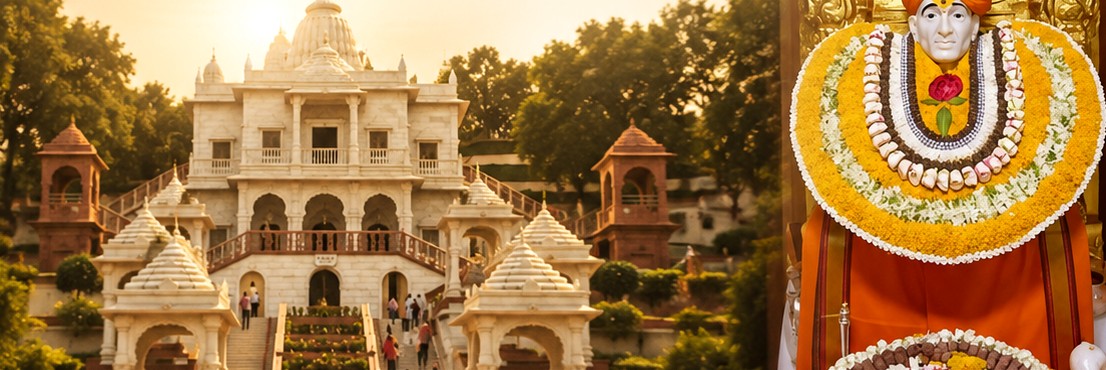
Of the eight Ashtavinayak shrines of Maharashtra, Chintamani at Theur is the one built for the burdened heart. Chinta — worry — is what the deity here is celebrated for removing, and the temple’s very name carries the promise: Chintamani, the jewel that dissolves anxiety. Set beside the confluence of the Mula and Mutha rivers barely 25 kilometres from Pune, in Haveli taluka of Pune district, Theur is the fifth shrine of the traditional yatra and by far the easiest to reach — which makes it, fittingly, the Ganesha that busy city-dwellers turn to most. Our team at Gajanan Maharaj Sansthan in Omkareshwar has a special fondness for this shrine’s gentle promise, and this guide covers its legend, timings, riverside setting and a practical morning-visit plan.
The Remover of Chinta
Every Ashtavinayak answers a human need — obstacles, boons, accomplishment — and Theur’s office is peace of mind. Pilgrims come here carrying the ordinary weight of the world: an ailing parent, a child’s exam, a business decision, an unresolved grief. According to tradition, to surrender one’s chinta at Chintamani’s door is to receive clarity in return, and priests say the temple’s steady stream of repeat visitors — people who come back year after year, not with new requests but with gratitude — is proof enough of the shrine’s pull.
The Legend Cycle of Theur
According to tradition, preserved in the Mudgala Purana lore that also carries Morgaon’s tales, the sage Kapila possessed the Chintamani — a wish-fulfilling jewel whose radiance banished want and worry. In the story, a prince, overcome by desire for the gem, took it away, and the sage’s anguish moved Lord Ganesha to intervene. The jewel was recovered, but sage Kapila, his attachment dissolved, laid the Chintamani at Ganesha’s feet and asked the Lord himself to dwell at the confluence of the Mula and Mutha as Chintamani — the jewel beyond all jewels. The association of Theur with the Morgaon legend cycle is a reminder that the eight shrines form one narrative garland, not eight separate stories.
The temple’s later history is intertwined with the Peshwas of Pune, who lavished patronage on the shrine. Historical accounts record that Madhavrao Peshwa, among the most beloved of the line and a deeply devoted pilgrim, passed his final days at Theur and was cremated on the riverbank nearby in the 1770s; a shrine in the precinct commemorates the association. Looking at the temple’s large wooden-pillared sabha mandap today, you are looking at Peshwa-era craftsmanship in the classic Maharashtra style.
The Mula-Mutha Confluence Setting
| Quick fact | Detail (approximate/indicative) |
|---|---|
| Location | Theur village, Haveli taluka, Pune district |
| Distance from Pune | 25–30 km, about 1 hour by road |
| Setting | Bank of the Mula–Mutha confluence |
| Yatra position | 5th of 8 in the traditional order |
| Classic pairing | Morgaon via the Jejuri side, same day |
Theur sits where the Mula and Mutha rivers meet before their waters flow on towards Pune, and the sangam gives the temple a stillness that belies its proximity to the city. The ghats below the temple are quiet in the mornings, and many yatris sit there after darshan simply watching the two rivers braid together — a sight that does its own quiet work on the mind. The temple’s whitewashed enclosure, deepamalas and large courtyard were designed for unhurried gathering; even on busy festival days, the precinct absorbs crowds gracefully.
Darshan Timings and a Morning Visit Plan
The temple typically opens around dawn, with kakada aarti in the early hours, abhishek through the morning and shejaarti closing the evening — though timings vary across seasons and festival days, so confirm with temple authorities before finalising your plan. Wednesdays, Sankashti Chaturthi and Ganesh Chaturthi draw the largest crowds; ordinary weekday mornings are calm.
A comfortable half-day plan from Pune:
- 7:00 AM — leave Pune, driving out via the Solapur road side towards Theur, approximately one hour depending on traffic.
- 8:00 AM — darshan and abhishek, ideally booked in advance if you wish to perform one; queues are shortest before mid-morning.
- 9:00 AM — prasad and the sangam, a slow walk down to the confluence and a few quiet minutes on the ghat.
- 10:00 AM — proceed onwards — back to Pune, or onwards to the Junnar-side shrines if you are on the full circuit.
The town has simple stalls for prasad and breakfast; note that the temple’s sanctum, like most, does not permit photography, and modest dress is expected.
Theur in the Yatra and Beyond
On the traditional sequence laid out in our Ashtavinayak Yatra circuit guide, Theur is the fifth darshan — the first stop of day two, placed perfectly to convert an early start into a peaceful beginning. From Pune, the favourite one-day loop pairs Theur with Mayureshwar at Morgaon on the Jejuri side: two darshans, approximately 100 to 130 kilometres of driving in total, and a lunch of Jejuri-belt thali in between — all comfortably done between breakfast and sunset. For travellers with more time, the same corridor extends towards Saswad’s Purandar country, though most pilgrims save that for another day.
A few notes from regulars:
- Go early, go weekday if you want the temple nearly to yourself.
- Do not skip the sangam — the rivers are half the reason Theur feels as it does.
- Combine with Morgaon for the easiest first taste of the Ashtavinayak from Pune.
- Check Sankashti dates if you want energy; avoid them if you want silence.
Summary
Chintamani at Theur is the Ashtavinayak for the anxious mind — a Peshwa-era temple on the Mula-Mutha confluence barely 25 to 30 kilometres from Pune where, according to tradition, the jewel of worrylessness is Lord Ganesha himself. Visit on a weekday morning for the calmest darshan, sit a while at the sangam, and pair it with Morgaon for a perfect first Ashtavinayak day. However far your travels take you — to the Junnar caves or, one day, to our river island at Omkareshwar — carry Theur’s lesson with you: that the simplest offering at Chintamani’s door is the worry you leave behind.
Frequently Asked Questions
How far is Theur from Pune?
Theur lies approximately 25 to 30 kilometres from central Pune, about an hour's drive via the Solapur road side. It is the closest of the eight Ashtavinayak temples to the city and the easiest to combine with a half-day outing.
Why is Chintamani at Theur called the worry-removing Ganesha?
Chinta means worry or anxiety in Sanskrit, and according to tradition, Ganesha at Theur relieves devotees of the burdens on their minds. The name is linked to the Chintamani jewel of the temple's legend, a gem said to grant peace and remove want.
What is the Peshwa connection to Theur temple?
The temple flourished under the Peshwas of Pune, and historical accounts record that Madhavrao Peshwa, a deeply devoted pilgrim, spent his final days at Theur and was cremated nearby in the eighteenth century. The Peshwas' patronage shaped much of the temple's present form.
Can Theur be combined with other Ashtavinayak temples?
Yes. On the traditional yatra it is the fifth shrine, visited on day two after an overnight around Pali or Mahad. From Pune it also pairs easily with Morgaon via the Jejuri side for a comfortable one-day loop.