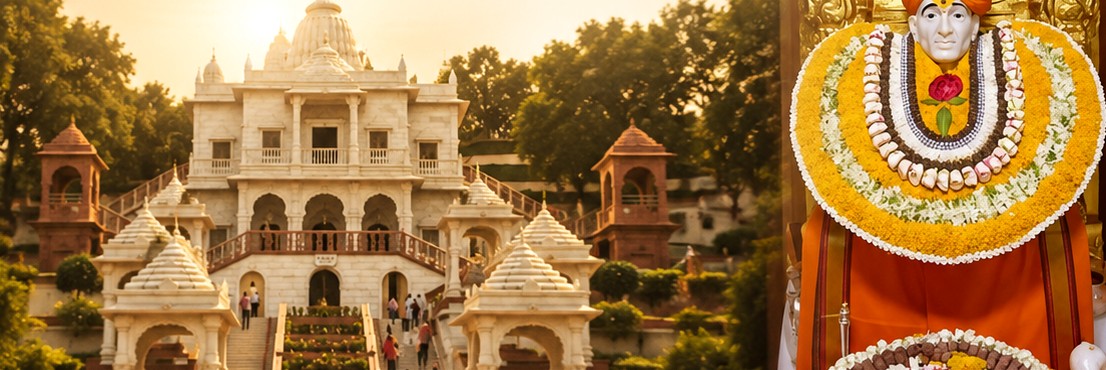
Mayureshwar Temple at Morgaon is where the Ashtavinayak Yatra traditionally begins and ends. Set in Bhor taluka of Pune district, in the Jejuri belt of Maharashtra, this shrine of Moreshwar — the peacock-riding Ganesha — is honoured as the adhyapak, the presiding teacher among the eight self-manifested Ganesha shrines of the state. For generations of Maharashtrian families, the yatra is incomplete until the pilgrim has bowed at Morgaon a second time, on the way home. At Gajanan Maharaj Sansthan in Omkareshwar, where Ganesha bhakti anchors our daily rhythm of seva, we hold Morgaon in special regard — so here is a complete guide to its legend, architecture, timings and routes, written the way we would brief a guest.
Moreshwar, the Adhyapak of the Eight
Among the Ashtavinayak shrines, Morgaon enjoys first place in both sentiment and sequence. According to tradition, the swayambhu murti of Mayureshwar manifested here of its own accord, and the temple has stood at the centre of Ganapatya devotion in western India for centuries. The deity is affectionately called Moreshwar — “Lord of the Moors,” a name local tradition links to the region’s peacocks (mor) and to Ganesha’s vahana, the peacock itself. Pilgrims approach the sanctum through a walled stone precinct that resembles a small hill fort, an architectural echo of the shrine’s stature as the circuit’s guardian.
It is customary for yatris to pick up a small packet of the temple’s bhandara — the fragrant sindoor-and-spice prasad — as a token of Moreshwar’s blessing for the journey ahead. Our full Ashtavinayak Yatra route guide explains how Morgaon anchors the two-day circuit across the other seven shrines.
The Legend of Mayureshwar
According to tradition, preserved in the Ganesha-related Puranic lore of the Mudgala Purana cycle, the demon Sindhu tormented the three worlds, and the gods sought Ganesha’s aid. Riding a divine peacock — hence the name Mayureshwar, “lord mounted on a peacock” — Ganesha is said to have engaged and defeated Sindhu at this spot, after which he chose to remain here permanently. Devotees traditionally murmur the phrase “Sindhu mardan Mayureshwar” in the deity’s praise, a reminder that obstacles big and small are said to dissolve before Moreshwar.
Another strand of tradition holds that Murcha, a fearsome demon defeated by Ganesha at Morgaon, gives the village its name — from “Murcha” to “Morgaon” over centuries of retelling. Villages grow stories as rivers grow bends, and the wise pilgrim receives both tellings with reverence rather than a historian’s frown.
Architecture and the Sacred Precinct
The temple you see today is a substantial stone structure in the traditional Maharashtra style, with a walled courtyard, deepamalas flanking the entrance, and a sabha mandap richly carved with figures from the Ganesha Purana tradition. Look closely and peacock motifs recur through the sculptural scheme — on pillars, lintels and brackets — a quiet signature of Mayureshwar’s identity. The presiding murti, coated thick with shendur (sindoor) applied by generations of priests, sits with a serpent’s hood traditionally shown sheltering it above; a Nandi and a mouse-riding Ganesha image keep guard in the precinct. Photography inside the sanctum is generally not permitted, and modest dress is expected — shoulders and knees covered, as at any living temple.
| Quick fact | Detail (approximate/indicative) |
|---|---|
| Location | Morgaon, via Jejuri, Pune district, Maharashtra |
| Distance from Pune | 65–75 km, roughly 1.5–2 hours by road |
| Nearest railhead | Jejuri station on the Pune–Miraj line |
| Famous prasad | Kandi pedha of Morgaon, and the temple bhandara |
| Best combined visit | Jejuri Khandoba temple, roughly 15–20 km away |
Darshan Timings and Aarti
The temple typically opens around dawn and closes by late evening, with the day punctuated by kakada aarti in the early hours, abhishek and naivedya through the morning, and shejaarti at night — but these vary by season and festival. Wednesdays, Sankashti Chaturthi and especially Angaraki Sankashti draw large crowds, and Ganesh Chaturthi sees the village transformed. Queues move briskly on ordinary weekdays; allow approximately one to two hours for darshan on festival days. Confirm current timings with temple authorities as schedules change.
How to Reach Morgaon from Pune
Morgaon is roughly 65 to 75 kilometres from Pune, most commonly approached via the Pune–Saswad–Jejuri road, a pleasant drive through farm country that takes approximately one and a half to two hours depending on traffic. By train, Jejuri station on the Pune–Miraj line is the practical railhead, about 15 to 20 kilometres from Morgaon, covered by shared autos and local buses. MSRTC buses run from Pune to Jejuri and onward towards Morgaon through the day. A hired taxi for the day costs indicatively INR 3,000 to 4,500 — confirm the fare at booking.
Two route ideas worth considering:
- The Jejuri combine: darshan at Jejuri’s famous Khandoba temple on the hill, followed by Moreshwar at Morgaon and, if time permits, a continuation to Chintamani at Theur or onwards to Mahaganapati at Ranjangaon — both lie on comfortable extensions from this corridor.
- The full circuit start: begin the traditional yatra here at dawn, proceed east towards Siddhatek, and let Morgaon’s bhandara sustain you for the road ahead.
Simple food stalls near the temple serve thalis and the region’s famed pedha; accommodation is basic in the village itself, so most pilgrims day-trip from Pune or Jejuri.
Summary
Mayureshwar at Morgaon is the gateway and goal of the Ashtavinayak Yatra — the adhyapak shrine where the circuit begins and, by tradition, must end. Reach it via Jejuri, approximately 65 to 75 kilometres from Pune, combine it with the Khandoba temple next door, and allow extra time around Sankashti and Chaturthi festival days. Come for the legend of the peacock-mounted lord who felled the demon Sindhu, stay for the unhurried village peace — and carry Moreshwar’s bhandara home as yatris have for centuries.
Frequently Asked Questions
Why is Morgaon the first Ashtavinayak temple?
Morgaon is regarded as the principal and adhyapak, or teacher's seat, of the eight Ashtavinayak shrines, so the traditional yatra begins and ends here with Mayureshwar's darshan. Pilgrims return to Morgaon after visiting the other seven temples to complete the circuit.
How far is Morgaon from Pune and Jejuri?
Morgaon lies approximately 65 to 75 kilometres from Pune by road, usually reached via Jejuri. Jejuri, home of the Khandoba temple, is only roughly 15 to 20 kilometres away, which makes the two darshans an easy combination in a single day.
What are the darshan timings at Mayureshwar Temple?
The temple generally opens in the early morning and remains open until late evening, with a midday break for maha-naivedya in many seasons. Schedules shift with festivals and Sankashti Chaturthi, so confirm current timings with temple authorities before you visit.
Can Morgaon and Jejuri be combined in one trip from Pune?
Yes, this is one of the easiest Ashtavinayak day trips from Pune — roughly 65 to 75 km each way with Jejuri en route. Start early to enjoy both temples comfortably and return to Pune by evening.