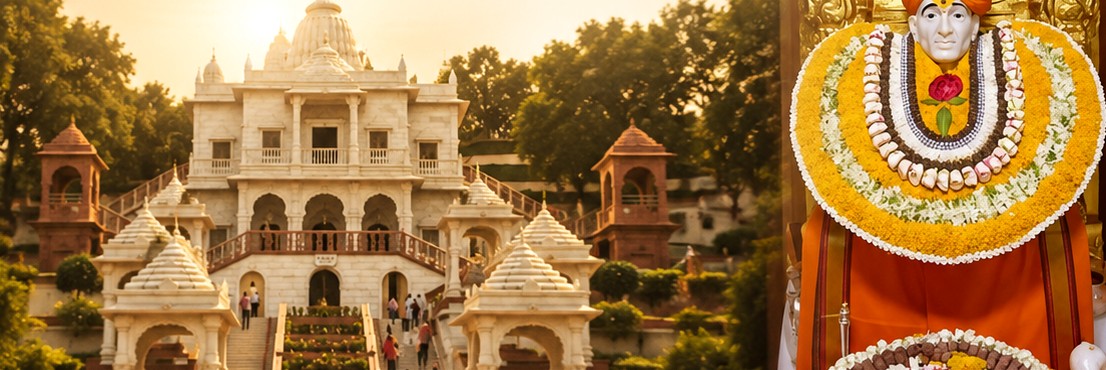
Mamleshwar temple architecture is Omkareshwar’s quiet masterpiece. While the island shrine draws the crowds and the cameras, the temple of Mamleshwar — also revered as Amareshwar — stands on the south bank of the Narmada, wrapped in carved stone that rewards the visitor who slows down. According to tradition, this south bank shrine and the island Jyotirlinga are two expressions of one sacred presence, a relationship we explore in our comparison of Mamleshwar and Omkareshwar; this article is devoted to the stones themselves — the plan, the shikhara, the carvings and the inscriptions that make this one of the most rewarding architectural visits on the Narmada.
The South Bank’s Quiet Masterpiece
Mamleshwar’s greatest architectural luxury is atmosphere. The courtyard is calm, the devotee flow gentler than the island’s, and the temple’s low, weathered walls sit close enough to touch. Where the island temple experience is immersive and kinetic, Mamleshwar invites study: you can circle the sanctum slowly, follow a frieze from one corner to another, and stand before a niche without being moved along. For pilgrims who love art and history, this difference is not a footnote — it is the reason to budget a full unhurried hour on the south bank.
| Quick detail | What to expect (indicative) |
|---|---|
| Location | South bank of the Narmada, opposite the island |
| Style | North Indian Nagara idiom, early medieval attributions |
| Highlights | Carved friezes, sculpted niches, Sanskrit inscriptions |
| Best visited | Early morning or late afternoon light |
| Access | Boat crossing or the hanging footbridge |
A Nagar-Style Shrine in Stone
The temple belongs to the Nagara tradition of North Indian temple architecture — the lineage of curvilinear shikharas, ribbed and rising, that distinguishes so much of the temple heritage of Madhya Pradesh. The present structure is generally attributed to the early medieval period per ASI-style records and scholarly descriptions, and like most living temples of great age, it carries layers: original cores, later additions, centuries of repair. Dating should be treated as indicative rather than exact, and those seeking precise chronology should consult the Archaeological Survey of India’s published material.
The plan is intimate rather than monumental. A sanctum for the Shiva linga, a hall for worshippers, and an enclosed courtyard whose walls carry the densest carving — a compactness that suits both ritual and contemplation. The masonry is of dressed stone blocks fitted without mortar in the classic manner, and the vertical faces are organised into horizontal bands, each band a register of sculpture. Look up at the shikhara’s base and you will find the smaller images that temper the whole: diminutive deities, lovingly repeated, marking the mountain-like tower as an image of the sacred world itself.
Carvings That Reward a Slow Walk
The walls of Mamleshwar are the main event. Set aside one full circumambulation for the carving alone, and keep an eye out for:
- Friezes of small figures in procession — dancers, musicians, and attendant beings running along the wall bands like a stone scroll.
- Sculpted niches housing deities, their faces softened by centuries of weather and touch.
- Architectural detail work — miniature temple motifs, pilasters and mouldings that show the carvers’ delight in repetition and variation.
- Carvings of river and fertility imagery traditionally associated with temple doorways and thresholds.
- The doorway frames, typically the most richly ornamented zone of any Nagara temple, layered with bands of ornament.
Early morning and late afternoon light rake across these walls and bring the relief alive in a way flat midday light never does — photographers will find this practical detail as valuable as any lens advice in our Omkareshwar photography guide.
Inscriptions: Voices from the Early Medieval Period
Mamleshwar’s inscriptions are its scholarly claim to fame. Long Sanskrit records are incised into the temple’s stone tablets and wall courses — donations, royal patronage and temple administration from centuries past — and they are generally attributed to the early medieval period per ASI-style records. Reading dates and dynasties from them is a specialist’s task, and attributions vary across sources, so treat any specific era you hear from a guide as approximate. What needs no specialist is the emotional effect: standing before a slab of blackened stone and realising that pilgrims a millennium ago left words here so that their gifts to this temple would be remembered — and that you, reading of them, are part of the same continuity.
An Art Lover’s Alternative to the Island Rush
For many visitors, Mamleshwar becomes the favourite of Omkareshwar’s two shrines precisely because it can be absorbed rather than merely attended. Combine it with the other great stone marvel of the area — the ancient fort-side temple of Siddhanath on the island’s rim, covered in our Siddhanath temple guide — and you have a small but genuine architecture trail of the Narmada valley: three buildings, three moods, one tradition of carved devotion.
Practical notes: reach the south bank by boat for the short crossing or by the hanging footbridge for the walk; allow approximately one to two hours; and visit in the softer light hours if the carvings are your priority. Temple rituals continue through the day, so time your architectural circumambulation between worship peaks, and confirm darshan timings with temple authorities as schedules change.
Summary
Mamleshwar temple architecture offers what the island shrine, for all its energy, cannot: stillness, proximity and time. A Nagara-style temple in dressed stone, attributed to the early medieval period per ASI-style records, it carries friezes, niched deities and long Sanskrit inscriptions that turn a short south bank visit into a journey through centuries of devotion. Cross the river, walk the walls slowly, let the light do its work — and leave with the understanding that according to tradition and stone alike, the presence worshipped on the island has always had a quiet home on this bank too.
Frequently Asked Questions
What is special about Mamleshwar temple's architecture?
Mamleshwar is admired for its early medieval stone architecture in the North Indian Nagara tradition, with finely carved friezes, sculpted deities in wall niches and long Sanskrit inscriptions. Unlike the busier island temple, it offers a quiet courtyard where the carvings can be studied at leisure.
How old is the Mamleshwar temple at Omkareshwar?
Parts of the present structure are generally attributed to the early medieval period, per ASI-style records and scholarly descriptions, with centuries of repair and rebuilding layered into the fabric. Visitors should treat dating as indicative and refer to official archaeological sources for details.
Is Mamleshwar the same as the Omkareshwar Jyotirlinga?
Tradition holds that the Omkareshwar Jyotirlinga on the island and Mamleshwar (also called Amareshwar) on the south bank are two forms of the same sacred presence, and many pilgrims take darshan at both. The two shrines are connected by boat and a hanging footbridge.