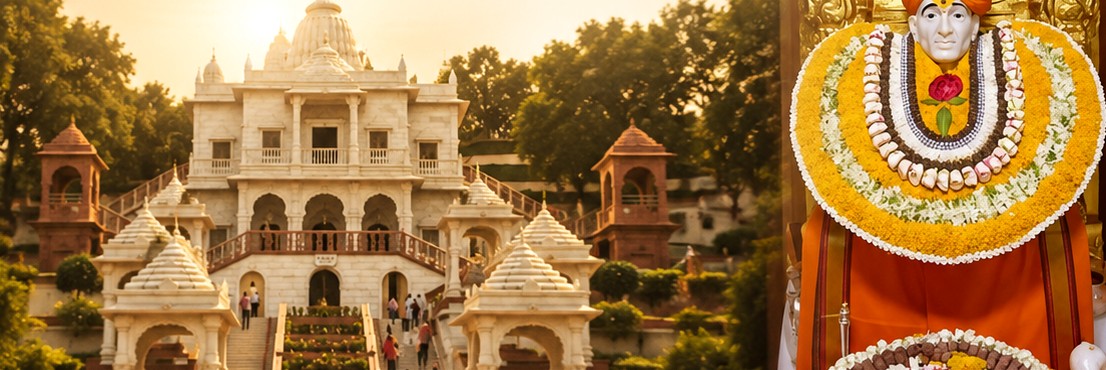
The Mahakaleshwar Jyotirlinga history is among the deepest in Indian tradition. At Ujjain — the ancient Avantika — on the banks of the Shipra river, Shiva is worshipped as Mahakal, the Lord of Time, in the form of a rare south-facing (Dakshinamukhi) linga believed to be self-manifested. Few shrines in India carry so many layers: a Puranic legend of divine intervention, a city counted among the seven great moksha-puris, and a temple that has been destroyed, rebuilt and now crowned with the modern grandeur of Mahakal Lok.
Avantika — Ujjain Among the Sacred Cities
Ujjain is one of the oldest continuously living cities of India. Traditional texts list it — as Avantika or Ujjayini — among the seven sacred cities of liberation, alongside Kashi, Ayodhya, Mathura, Haridwar, Kanchi and Dwaraka, where devotees believe liberation may be attained. The city also held a special place in ancient Indian astronomy: scholars traditionally treated Ujjain’s longitude as a reference meridian for timekeeping and calendar calculations, a fact that resonates beautifully with its presiding deity being the Lord of Time himself. The Skanda Purana and other texts celebrate Avantika as a city where Shiva is ever-present, which is why pilgrims have come here for well over two millennia.
The South-Facing (Dakshinamukhi) Linga
What most distinguishes Mahakaleshwar among the twelve Jyotirlingas is its orientation. The linga faces south — Dakshinamukhi — and is revered as swayambhu, self-manifested rather than installed by human hands. The south is the direction associated in tradition with Yama, death and the ending of things; that Shiva faces it unafraid expresses his identity as the one beyond time and death. This orientation also shapes the temple’s unique worship, including the famed pre-dawn Bhasma Aarti, in which sacred ash — the residue of all that time consumes — is offered to the Lord daily. Devotees regard darshan of the south-facing Mahakal as exceptionally powerful for confronting fear and seeking protection.
The Legend of the Jyotirlinga’s Origin
According to tradition, recounted in the Shiva Purana’s account of the Jyotirlingas, the story begins in a Ujjain ruled by the devout King Chandrasena. A young boy named Shrikar, moved by hearing of the king’s worship of Shiva, began offering his own innocent devotion at a linga. Rival rulers, coveting the city, laid siege to it with their armies, and a terrible demon associated with the siege threatened the devout. When the king and the boy’s prayers rose together, the earth is said to have split open and Shiva manifested as Mahakal, destroying the threat and restoring peace.
At the fervent request of Chandrasena, Shrikar and the people, the Lord then chose to remain at Avantika as the swayambhu, south-facing linga — the Mahakaleshwar Jyotirlinga. Legends like this, preserved and retold over centuries, are a matter of living faith rather than documented chronicle, and pilgrims will hear them lovingly narrated by the temple’s priests today. Readers who enjoy such traditions may also like the parallel legend of the Omkareshwar Jyotirlinga at the sister shrine on the Narmada, and our overview of the twelve Jyotirlingas and their locations.
Mahakal — The Lord of Time
The name at the heart of this shrine deserves reflection. Maha means great; kala means time — and also death. Mahakal is the Great Time, the power before which all things arise and dissolve, and the one who, being beyond time, can protect devotees from its terrors. Every element of the temple’s worship echoes this: the ash offered at dawn, the south-facing orientation, and the city’s ancient association with the measurement of time itself. For pilgrims, darshan of Mahakal is thus not merely a ritual visit but a meditation on impermanence and the refuge that lies beyond it.
The Temple’s Layered Past
The temple’s material history, like much of India’s sacred architecture, is one of loss and renewal. Broadly — and with appropriate hedging, as scholars differ on details — the story runs as follows:
| Era | What history and tradition suggest (approximate) |
|---|---|
| Ancient period | Avantika’s Shiva worship celebrated in the Puranas; the city a major centre of learning and astronomy |
| Medieval period | Historical accounts attribute destruction of the earlier temple to raids from the Delhi Sultanate, commonly placed in the 13th century |
| Maratha period (18th–19th c.) | Much of the present multi-tiered structure rebuilt under Maratha patronage, notably by the Scindias of Gwalior |
| Modern era | Conservation, expansion of facilities, and the Mahakal Lok corridor development opened in phases from around 2022 |
The temple stands beside the Rudra Sagar tank, and its five-storeyed form with its distinctive shikhara remains the visual anchor of Ujjain’s old quarter. The shrine’s living traditions continue to grow too — most visibly in the Simhastha Kumbh, the great gathering held here roughly every twelve years, which you can read about in our Ujjain Simhastha Kumbh guide.
Summary
The history of the Mahakaleshwar Jyotirlinga weaves together the ancient sanctity of Avantika, the rare self-manifested south-facing linga, the moving legend of Shiva emerging as the Lord of Time to protect his devotees, and a temple repeatedly rebuilt by devotion across the centuries — most recently reimagined through Mahakal Lok. To stand before Dakshinamukhi Mahakal is to stand, tradition says, before the one who masters time and death. For pilgrims of Omkareshwar, the sister Jyotirlinga barely 140 km away, Ujjain completes a sacred pair — and understanding its layered past makes every darshan here richer.
Frequently Asked Questions
Why is the Mahakaleshwar linga south-facing?
According to tradition, the Mahakaleshwar linga is Dakshinamukhi — south-facing — and self-manifested, a rare orientation among the twelve Jyotirlingas. The south is associated with death and time, and Shiva here is worshipped as Mahakal, the Lord who conquers both.
What is the legend behind the Mahakaleshwar Jyotirlinga?
According to tradition recounted in the Shiva Purana, when a demon threatened the devout king and people of Ujjain, Shiva emerged from the earth as Mahakal and destroyed him, then agreed to reside there as a swayambhu linga at the request of devotees.
How old is the Mahakaleshwar temple?
The shrine's sanctity is described in ancient texts, but the present stone temple is largely the product of rebuilding after medieval damage, with much of the current structure shaped during the 18th–19th century Maratha period, particularly under Scindia patronage.