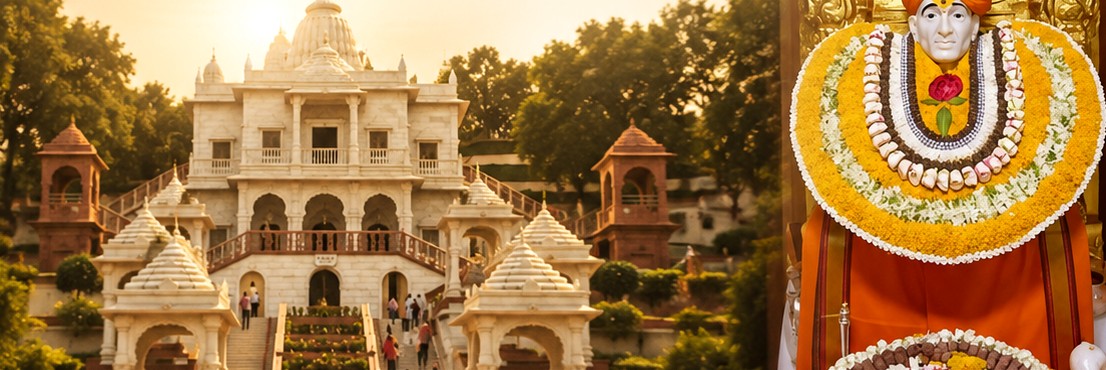
There are temple visits you make by car, and there are temple visits you earn. Girijatmaj at Lenyadri belongs to the second kind. The sixth shrine of the Ashtavinayak Yatra hides inside an ancient rock-cut cave high on a hill in Junnar taluka of Pune district, reached by a stone stairway of approximately 280 to 300-plus steps that every pilgrim — young, old, eager, weary — must climb on foot. According to tradition, this is where the goddess Parvati, called Girija, performed penance to receive Ganesha as her son; the deity here is Girijatmaj, the son of Girija. At Gajanan Maharaj Sansthan in Omkareshwar, where our own parikrama path rewards every step, we regard Lenyadri as the Ashtavinayak that best teaches what a little effort buys.
A Shrine within Ancient Caves
Lenyadri’s hillside holds a remarkable series of rock-cut caves dating back well over a millennium, part of the extraordinary heritage of Junnar — one of India’s richest clusters of ancient cave architecture. According to tradition, the Ganesha shrine occupies the cave counted eighteenth in the series, and it is the only Ashtavinayak housed in a cave. Scholars generally associate the caves’ earliest phase with Buddhist monastic communities, later absorbed into Hindu worship — a layered history that pilgrims can feel in the chaitya-arch windows and monolithic walls around them.
The murti itself is distinctive: carved in relief directly from the cave’s living rock rather than installed as a free-standing idol, a single-faced form of Ganesha gazing out over the valley. The sanctum is intimate, the cave’s mouth opens to hill air, and the darshan carries the unmistakable atmosphere of the ancient Deccan.
The Legend of Girija’s Son
According to tradition, preserved in the Ganesha Purana lore attached to the Ashtavinayak cycle, Parvati longed for Ganesha as her own child and performed stern penance in these hills for years on end. Pleased by her devotion, her wish was fulfilled, and the cave shrine commemorates the mother-son bond at the heart of the name: Girijatmaj, “Girija’s son.” Devotees — especially women praying for children and mothers praying for their children’s wellbeing — have long been drawn to this shrine for exactly this reason. The tradition also holds that the surrounding caves once sheltered sages, whose presence still lends the hill its charged quiet.
The Climb: What to Expect
| Quick fact | Detail (approximate/indicative) |
|---|---|
| Location | Lenyadri, Junnar taluka, Pune district |
| Distance from Pune | 90–100 km via Narayangaon, 2.5–3 hours |
| Steps to climb | Approximately 280–300+ |
| Typical climb time | 20–40 minutes with pauses |
| Nearest companion shrine | Ozar’s Vighneshwar, about 15–20 km |
The stairway begins at the hill’s base, where footwear stalls, water sellers and resting benches mark the start. The steps are stone, uneven in places, and largely exposed to the sun, so time your climb for morning or late afternoon, especially from March to June. Most walkers take 20 to 40 minutes with pauses; the pace matters far less than the footwear — closed walking shoes are strongly advised, and monsoon weeks make the steps slippery enough to warrant caution or postponement. Elderly pilgrims and those with joint trouble can enquire locally about palanquin (doli) services carried by handlers, for an indicative charge of a few hundred to about one thousand rupees depending on demand — confirm rates on the spot, and treat all figures as approximate.
Water, ors, and cut fruit are sold along the route, but carry your own bottle as well. The descent, gentler on the lungs and harder on the knees, rewards you with a view of the Kukadi valley that many pilgrims call the finest of the entire Ashtavinayak circuit.
Darshan Details and Timings
The shrine generally opens in the morning and closes by evening, with the day’s abhishek and aarti slots following the season — timings at hill temples shift with daylight and festival dates, so confirm with temple authorities before you travel. Sankashti Chaturthi and Ganesh Chaturthi bring large crowds, and on such days the stairway itself becomes the queue, adding an hour or more to the round trip. The cave sanctum is small, so darshan moves in slow waves; patience is not optional, it is the practice. Photography inside the sanctum is generally not permitted, and the usual temple etiquette — modest dress, covered shoulders and knees — applies.
The Junnar Circuit with Ozar
Almost every pilgrim pairs Lenyadri with Vighneshwar at Ozar, the seventh Ashtavinayak, which sits on the bank of the Kukadi river roughly 15 to 20 kilometres away — a flat, easy counterpoint to the morning’s climb. The practical base is Junnar town, where food and basic lodging are available; Narayangaon, on the way from Pune, is the other common stop. From Pune, the drive of approximately 90 to 100 kilometres runs via Chakan and Narayangaon in about two and a half to three hours. For the full sequencing — Theur before, Ozar after, Ranjangaon to close — see our Ashtavinayak Yatra circuit guide.
Travellers drawn to Lenyadri’s ancient stonework often enjoy extending the theme: our essay on Mamleshwar’s temple architecture explores the sister heritage of stone-carved shrines at Omkareshwar, on the Narmada — another reason pilgrims give for combining a Maharashtra circuit with a visit to our Sansthan.
A final checklist for the hill:
- Start early — the steps before the sun harden are a different experience altogether.
- Wear real shoes — the single most common regret on this climb.
- Pause and look back — the valley earns the interruption.
- Carry cash in small notes for water, doli services and prasad.
Summary
Girijatmaj at Lenyadri is the Ashtavinayak you climb towards — a cave shrine carved into a Junnar hillside some 280 to 300-plus steps above the valley, where, according to tradition, Parvati’s penance was answered with Ganesha as her son. Reach it from Pune via Narayangaon over approximately 90 to 100 kilometres, pair it with Ozar’s Vighneshwar nearby, and go prepared with shoes, water and an unhurried heart. The cave at the top is worth every step — and the steps, most pilgrims agree, are half the darshan.
Frequently Asked Questions
How many steps lead to the Girijatmaj temple at Lenyadri?
The climb is commonly counted at approximately 280 to 300-plus stone steps, taking most visitors about 20 to 40 minutes with pauses. Elderly pilgrims and those with knee trouble should allow more time and consider the palanquin services that operate on the hill.
What makes Lenyadri unique among the Ashtavinayak temples?
It is the only one of the eight set inside a rock-cut cave shrine, traditionally counted as the eighteenth cave of the ancient Lenyadri series near Junnar, and the only Ashtavinayak on a hill. The murti is carved in relief on the cave wall itself rather than installed as a separate idol.
What is the legend of Girijatmaj at Lenyadri?
According to tradition, the goddess Parvati — also called Girija — performed penance in these hills wishing for Ganesha as her son, and her wish was granted. The deity is therefore worshipped here as Girijatmaj, the son of Girija.
How do I reach Lenyadri from Pune, and can it be combined with Ozar?
Lenyadri lies approximately 90 to 100 kilometres from Pune via Narayangaon in Junnar taluka, about two and a half hours by road. Vighneshwar at Ozar is roughly 15 to 20 kilometres away, and the two are almost always visited together on the Junnar circuit.