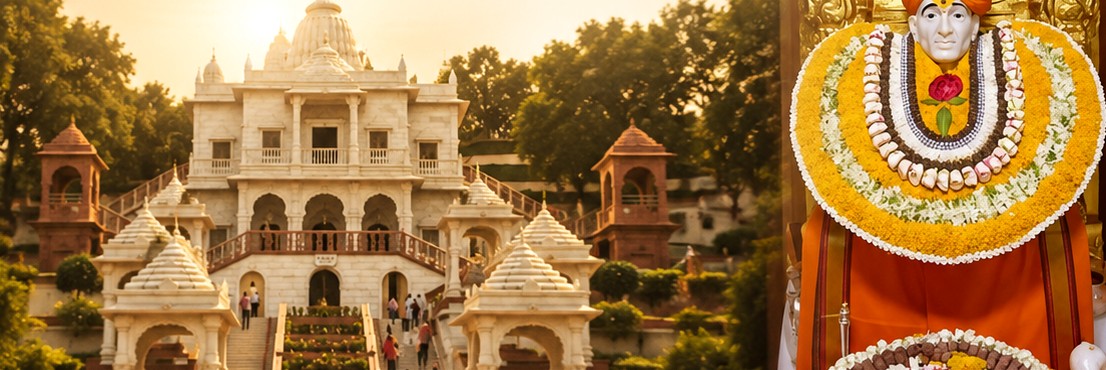
After the climb of Lenyadri, the road descends into the Junnar plain and runs a short distance to the bank of the Kukadi river, where the seventh Ashtavinayak waits in gold. Vighneshwar at Ozar — “the Lord of Vighnas, of obstacles” — is the shrine devotees seek when a path seems blocked, a plan keeps stalling, a beginning refuses to begin. The temple’s golden dome above the riverbank, the banyan shade of the precinct and the unhurried village around it make Ozar one of the warmest darshans of the eight. This guide from our team at Gajanan Maharaj Sansthan, Omkareshwar, covers the legend, the setting, the timings and the classic pairing with Lenyadri.
Vighneshwar, Lord of Obstacles
Every Hindu undertaking traditionally opens with a salutation to Ganesha as Vighneshwara — the remover (and, in his will, the placer) of obstacles. At Ozar, that universal office has a home and a name. According to tradition, preserved in the lore of the Ganesha Purana associated with the Ashtavinayak cycle, the demon Vighnasura bedevilled the sages’ rituals and the world’s work, spawning obstacles wherever earnest effort was made. The aggrieved rishis prayed to Ganesha, who subdued the demon; humbled, Vighnasura begged for grace, and the Lord forgave him on the condition that henceforth obstacles would bow where devotion was sincere.
In most tellings, the demon then asked that the place be graced by Ganesha’s permanent presence, and the Lord settled here on the Kukadi as Vighneshwar — the very name a promise that no obstruction is final. Devotees beginning new ventures — a shop, a house, a marriage, a journey — traditionally include Ozar in their prayers.
The Kukadi Riverbank Setting
| Quick fact | Detail (approximate/indicative) |
|---|---|
| Location | Ozar village, Junnar taluka, Pune district |
| Distance from Pune | 85–95 km via Chakan–Narayangaon, about 2.5 hours |
| Setting | Bank of the Kukadi river |
| Yatra position | 7th of 8 in the traditional order |
| Classic pairing | Lenyadri’s Girijatmaj, about 15–20 km away |
Ozar sits low by the Kukadi, a river that runs quiet for most of the year and full in the monsoon. The temple complex is generous — a wide courtyard, deepamalas, a large gateway and the east-facing sanctum of the swayambhu murti, which tradition describes as rich with sindoor. Pilgrims often complete a small pradakshina of the precinct and then walk the few paces to the riverbank, where steps lead down to the water; a few minutes there, watching the Kukadi slide past, belongs properly to the visit. The bazaar lane outside sells the usual prasad, flowers and the simple snacks that fuel the Junnar circuit.
The Golden Dome
What most visitors remember first is the colour. The temple’s dome and portions of its superstructure are covered in gold, and in the low sun the shrine seems lit from within. According to local tradition, the gilding grew from generations of devotees’ offerings made in gratitude for obstacles removed — though exactly when the gold was applied is variously told, and the honest pilgrim receives the dome as a beautiful accretion of bhakti rather than a dated monument. Inside, the sanctum keeps to the classic intimacy of the Ashtavinayak shrines: close, unhurried darshan, sindoor-scented air, and the hum of continuous prayer.
Darshan Timings and Practicalities
The temple generally opens around dawn and closes by evening, with abhishek and aarti through the morning and larger gatherings on Wednesdays, Sankashti Chaturthi — especially Angaraki Sankashti — and Ganesh Chaturthi. Timings vary across seasons and festival days, so confirm with temple authorities before locking your schedule. Ozar is less crowded than Morgaon or Ranjangaon on ordinary days, and darshan is usually smooth; the main planning variable is simply the distance from your starting point.
A few practical notes:
- Modest dress as always — shoulders and knees covered, footwear at the stands.
- No photography inside the sanctum — the courtyard and riverbank are fair game.
- Combine meals in Junnar — the town has the circuit’s most reliable simple restaurants.
- Carry small cash for prasad, parking and riverbank stalls.
Combining Ozar with Lenyadri
The Junnar pairing is one of the Ashtavinayak Yatra’s natural rhythms: climb to Girijatmaj at Lenyadri in the cooler morning, descend, and offer the easy riverside darshan at Ozar before lunch. The two shrines are roughly 15 to 20 kilometres apart, both set against Junnar’s ancient cave-studded hills. On the traditional sequence — Morgaon, Siddhatek, Pali, Mahad, Theur, Lenyadri, Ozar, Ranjangaon — this is the seventh darshan, with only Mahaganapati remaining before the return to Morgaon; our Ashtavinayak Yatra circuit guide lays out the full day-wise plan with hedged distances.
From Pune, allow approximately two and a half hours for the 85 to 95 kilometre drive via Chakan and Narayangaon; from Mumbai, the route via the Nashik highway side or through Pune both run long, so most pilgrims base themselves in Pune or overnight at Junnar. A hired taxi covering Lenyadri and Ozar in a day from Pune costs indicatively INR 5,000 to 7,000 — confirm at booking, as rates vary with season and fuel.
Summary
Vighneshwar at Ozar is the obstacle-remover with a river for a companion — a golden-domed shrine on the Kukadi in Junnar taluka where, according to tradition, a defeated demon’s grace became the world’s promise that beginnings need not be blocked. Visit it after the Lenyadri climb, 15 to 20 kilometres away, over approximately 85 to 95 kilometres of driving from Pune, and confirm timings with temple authorities before you go. Come with whatever stands stuck in your life, leave it at the golden door — and, as yatris have always done, take the Kukadi’s quiet with you when you drive on.
Frequently Asked Questions
What is the legend of Vighneshwar at Ozar?
According to tradition, the demon Vighnasura created obstacles that troubled the world's sages, who prayed to Ganesha. After the demon was subdued, he sought the Lord's grace, and Ganesha — taking the name Vighneshwar, lord of obstacles — is said to have dwelt here on the Kukadi riverbank.
How far is Ozar from Pune and Lenyadri?
Ozar lies approximately 85 to 95 kilometres from Pune via Chakan and Narayangaon, about two and a half hours by road. Girijatmaj at Lenyadri is roughly 15 to 20 kilometres away, and the two shrines are almost always visited together on the Junnar circuit.
What is Ozar temple famous for architecturally?
The temple is noted for its golden dome and gateway, which give the riverside shrine its distinctive glow at sunrise and sunset. The goldwork's exact history is a matter of local tradition, with devotees associating it with offerings accumulated over generations of gratitude.
What are the darshan timings at Vighneshwar Temple Ozar?
The temple typically opens in the early morning and closes by evening, with abhishek and aarti through the day and larger crowds on Sankashti Chaturthi and Ganesh Chaturthi. Confirm current timings with temple authorities as schedules change with season and festivals.