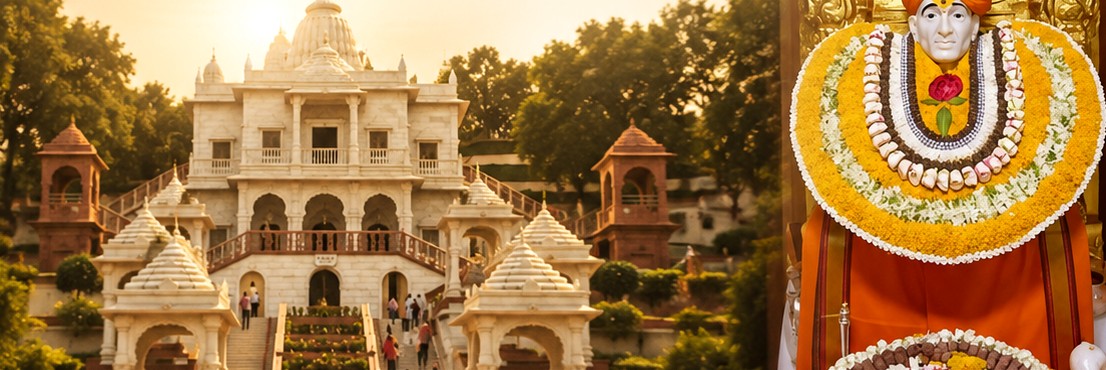
Amarkantak — the Narmada Udgam — is where the story of Omkareshwar’s river begins. Every drop of the Narmada that swirls around the Om-shaped island, that receives the lamps of the evening aarti, that pilgrims cup in their hands as prasad, starts as a young stream on a forested plateau in the Anuppur district of Madhya Pradesh. For devotees whose yatra has been shaped by the river, visiting her source completes a circle: you have taken her darshan at Omkareshwar; now you travel to her birthplace. The Narmada’s meaning for pilgrims — her status as a living goddess in tradition — is explored in our essay on the significance of the Narmada (Reva) river; this guide covers the practical pilgrimage to Amarkantak itself.
Where the Narmada Begins: Tradition and Terrain
According to tradition, the Narmada is no ordinary river: she is a goddess, born of Shiva’s compassion at Amarkantak, and — uniquely among India’s great rivers — she flows westward to meet the Arabian Sea. Where most rivers are said to require the agency of others for sanctity, tradition holds that the Narmada is purifying by her own nature, and pilgrimage to her source has therefore been a settled practice for many centuries.
Geographically, Amarkantak sits at approximately 1,000-plus metres above sea level in the Maikal hills, where the Vindhya and Satpura ranges meet. The plateau is cool, green and forested — a striking contrast with the hot plains the river later crosses. The air carries a hill-station crispness at dawn, and the town lives at the unhurried tempo of a pilgrimage centre rather than a tourist one.
The Narmada Udgam Temple and Kund
The focal point of any visit is the Narmada Udgam — literally, the “emergence of the Narmada” — where a temple complex has grown around the kund (pool) at the river’s traditional source. Pilgrims gather at the kund for darshan and ritual offering; the atmosphere in the early morning, with bells, chants and the young river barely a stream wide, is moving in a way that surprises many first-time visitors.
A few notes for the visit:
- Morning hours are the most atmospheric and the coolest for walking between the shrines.
- The complex includes multiple small temples around the main kund; walk it slowly rather than rushing to the main spot.
- Ritual offerings can be made at the kund — settle any priestly charges in advance and keep them modest.
- Timings of specific rituals change through the year; confirm with temple authorities as schedules change.
Kapildhara Falls and the Young River
Approximately 8–10 km from the main Udgam complex, the river makes her first great gesture: Kapildhara Falls, where the young Narmada drops over a rock face into a forested gorge. Named after the sage Kapila according to tradition, the falls are reached by road followed by a short walk, and the viewpoint puts the river’s newborn energy on full display. In and just after the monsoon, the falls are at their most powerful; in the dry season, the veil thins but the setting remains beautiful.
Elsewhere on the plateau, other points along the young river — small temples, forest clearings and stream crossings — reward travellers with their own time. Guarded walking, sensible footwear and daylight planning matter here: paths can be slippery, and the plateau’s distances are deceptive.
Ancient Temples of the Amarkantak Plateau
Amarkantak’s temple heritage goes well beyond the Udgam complex. Scattered across the plateau are groups of ancient stone temples — small, weathered and often dramatically sited — generally attributed to the Kalachuri period per common historical accounts, though dating varies by source and should be treated as approximate. Their carved walls, quiet courtyards and forest settings make them a condensed lesson in central Indian temple art. A morning spent moving between these temple groups, unhurried, with a local guide or a good map, is for many visitors the highlight of the trip — a scholarly and devotional pilgrimage in one.
Getting There from Omkareshwar
Amarkantak lies approximately 230–260 km from Omkareshwar by road, most commonly routed via Khandwa, and journeys generally take the better part of a day depending on road conditions, stops and the season. The table below gives an indicative frame; confirm current road and rail conditions while planning.
| Routing option | Approximate distance | Approximate travel time | Notes |
|---|---|---|---|
| Omkareshwar → Khandwa → Amarkantak (road) | Roughly 230–260 km | Approximately 6–8 hours | Most common route; break the drive at Khandwa |
| Via rail + road combinations | Varies by connection | Approximately 8–10 hours | Involves Khandwa-area junctions and a final road leg |
| Overnight halt at Khandwa | Split journey | Two shorter days | Recommended for elderly travellers and families |
Practical advice: hire a reliable car with a driver who knows the ghat section onto the plateau, start early, and treat the journey as part of the yatra rather than an obstacle to it. Accommodation at Amarkantak ranges from simple dharamshalas to mid-range hotels and trust-run guesthouses; book ahead for festival periods and treat tariffs as indicative until confirmed at booking.
Making It a Source-and-Jyotirlinga Yatra
Pilgrims who have felt the Narmada’s presence at Omkareshwar often describe Amarkantak as the completion of a relationship: you have stood where she is mighty; now stand where she is born. The logic extends naturally — those undertaking the great river pilgrimage will find our full Narmada parikrama route guide a natural next reading. And for pilgrims drawn to sacred origins in general, the sister essay on Gangadwar at Trimbakeshwar, the source of the Godavari, tells the same story for another great river — a reminder that in Indian tradition, geography itself is scripture.
Plan a minimum of one night at Amarkantak: arrive in the evening, take the Udgam darshan at dawn, spend the day on the falls and temple groups, and descend the next morning. Rushing the plateau in a day flattens precisely the quiet the place exists to offer.
Summary
Amarkantak is the Narmada’s first shrine — a cool forest plateau where, according to tradition, a goddess was born and began her westward journey to the sea. Visit the Narmada Udgam temple and kund, walk the ancient Kalachuri-attributed temple groups, stand at Kapildhara Falls approximately 8–10 km away, and travel the approximately 230–260 km from Omkareshwar with an overnight plan rather than against the clock. Confirm timings and road conditions as you go, book rooms ahead in season, and let the source be what it is: the beginning of every blessing the river has ever carried past the island of Om.
Frequently Asked Questions
Where does the Narmada river originate?
According to tradition and Hindu scripture, the Narmada originates at Amarkantak in the Anuppur district of Madhya Pradesh, at a spot revered as the Narmada Udgam. The river is unique among major Indian rivers in flowing westward, from the highlands of central India to the Arabian Sea.
How far is Amarkantak from Omkareshwar?
The road distance is approximately 230–260 km depending on the route, most commonly travelled via Khandwa, and the journey generally takes the better part of a day. Many pilgrims break the trip with an overnight halt rather than driving it in one stretch.
What should I see at Amarkantak besides the Narmada Udgam?
Pilgrims typically visit the Narmada Udgam temple and kund, the ancient temple groups of the plateau, and Kapildhara Falls, approximately 8–10 km away, where the young river tumbles down its first major descent. Allow one to two unhurried days for the main sights.