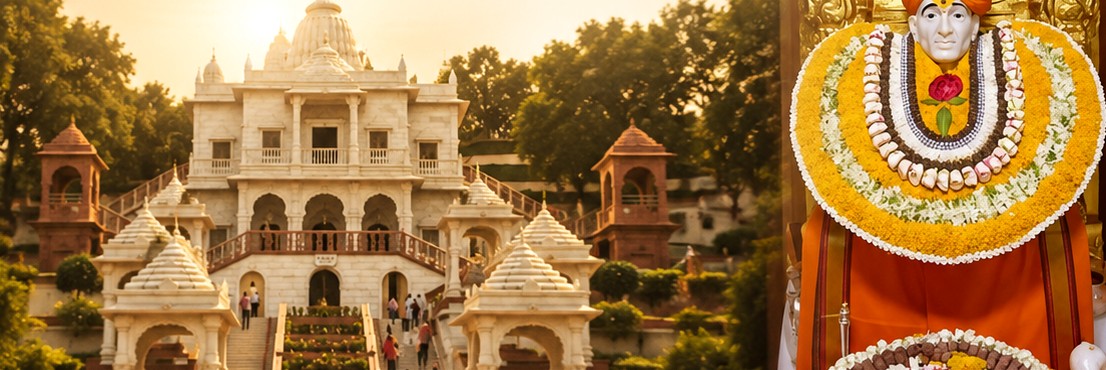
On the western tip of Saurashtra, where the Gomti’s last steps meet the Arabian Sea, stands the Dwarkadhish Temple of Dwarka — the temple of Krishna as the Lord of Dwarka. For Vaishnavas it is among the holiest places on earth; for Shaivas it is the gateway to nearby Nageshwar; and for every pilgrim it is one of the four abodes of the Char Dham. This guide covers the tradition, darshan timings and mangla aarti, the boat journey to Bet Dwarka, the Rukmini temple, and how to plan your visit to Krishna’s city by the sea.
Krishna’s Dwarka: The Living Tradition
According to tradition, after leaving Mathura, Lord Krishna established his new capital at Dwarka on the Gujarat coast, and the city became the stage for many of the Mahabharata’s later chapters. The Puranas recount that when Krishna’s earthly sojourn ended, the sea rose and withdrew the golden city beneath its waves — a tradition that devotees often connect with the submerged structures that marine archaeologists have reported exploring off the modern coastline.
Whatever one makes of the undersea findings, the living tradition is unambiguous: Dwarka is worshipped as Krishna’s own city, and the Dwarkadhish Temple on its shore as his royal seat. The deity here is honoured as a king — Dwarkadhish, the Lord of Dwarka — and rituals through the day follow a regal rhythm of waking, bathing, feeding and resting.
The Jagat Mandir and Its Architecture
The temple, also affectionately called Jagat Mandir, is a five-storey structure built on 72 pillars by traditional reckoning, its soaring shikhara rising approximately 70–80 metres per common descriptions. The carved facade, the flag — the temple’s dhwaja — flying from the summit, and the stone steps of Gomti Ghat descending to the sea together form one of the most recognisable skylines in Indian pilgrimage.
The flag itself holds a special place in the temple’s life: by long-standing practice it is changed multiple times a day, and devotees consider sponsoring a flag (dhwaja pooja) an auspicious seva — ask at the temple office about current arrangements if you wish to participate.
Darshan Timings and Mangla Aarti (Verify Before You Go)
| Session | Approximate Time | Notes |
|---|---|---|
| Mangla aarti and opening | Around 6:00–6:30 AM | The most serene darshan of the day |
| Morning darshan | Until about 12:30–1:00 PM | Followed by a midday closure |
| Evening reopening | Around 4:30–5:00 PM | Includes shringar and sandhya rituals |
| Night close | Around 9:00–9:30 PM | queues lengthen on weekends and festivals |
Special darshan arrangements and seva tickets are managed by the temple board office; fees are nominal but policies change, so confirm with temple authorities as schedules change. During Janmashtami and the festival calendar of the Vallabhite and Vaishnava traditions, the temple takes on a wholly different, joyous character.
Beyond the Main Temple: Bet Dwarka, Rukmini Temple and Gomti Ghat
- Bet Dwarka: Reached by driving approximately 30–35 km to Okha and then boarding a boat (roughly a 20–30 minute crossing; fares are nominal, reportedly a few tens of rupees), the island of Bet Dwarka is revered as Krishna’s residence. According to tradition, this is where Krishna lived with his family, and the island holds several small shrines along with memories of Sudama’s visit. Ferries generally run from morning to late afternoon — go early, as sea conditions can suspend services.
- Gopi Talav: En route to Bet Dwarka, this small lake is associated, according to tradition, with the gopis who came to Dwarka to meet Krishna.
- Rukmini Temple: About 2 km from the main temple stands the shrine of Rukmini, Krishna’s chief queen — an elegantly carved temple believed to be many centuries old. Its isolated quietness contrasts movingly with the bustle of Dwarkadhish.
Dwarka and the Char Dham
Dwarka’s spiritual stature is inseparable from the Char Dham — Badrinath, Dwarka, Puri and Rameshwaram — which, according to tradition, was established by Adi Shankaracharya as the four abodes marking the compass points of India. Many pilgrims who reach Dwarka from our home region of Omkareshwar describe a satisfying sense of completeness: one ocean-facing abode in the west, paired in spirit with the island shrine of Rameshwaram in the south. Others extend the idea to the Himalayan circuit with our guide to the Chota Char Dham Yatra. If your journey begins at Somnath, our Somnath to Dwarka travel guide explains the coastal route.
How to Reach Dwarka and Where to Stay
Dwarka has its own railway station, well connected toward Ahmedabad and Okha, and long-distance travellers usually fly into Jamnagar airport, approximately 130–150 km away, or Rajkot farther on. State buses and private vehicles link Dwarka with Somnath (approximately 230–240 km), Rajkot and Ahmedabad. Accommodation ranges from simple dharamshalas near the temple to mid-range hotels; indicative tariffs are roughly INR 400–3,000 per night, with festival-season premiums — confirm at booking. Book early for Janmashtami, when the town overflows with pilgrims.
Summary
The Dwarkadhish Temple rewards the unhurried pilgrim: mangla aarti at dawn when the sea is calm, the flag changing atop the shikhara, a midday boat pilgrimage to Bet Dwarka, and a quiet evening darshan of Rukmini’s shrine. Keep timings approximate and confirm locally, travel early to the jetty, and leave room in your plan for the sheer joy of standing in Krishna’s capital by the Arabian Sea. Paired with Somnath and Nageshwar nearby, Dwarka completes a western India pilgrimage that devotees remember for a lifetime.
Frequently Asked Questions
What are the Dwarkadhish Temple darshan timings?
The temple generally opens before dawn, around 6:00–6:30 AM, with mangla aarti, closes around midday, and reopens in the late afternoon until about 9:00–9:30 PM. Confirm with temple authorities as schedules change with seasons and festivals.
How do I go to Bet Dwarka from Dwarka?
Bet Dwarka is reached by road to Okha, approximately 30–35 km from Dwarka, followed by a boat ride of roughly 20–30 minutes. Ferries generally run from morning to late afternoon, weather permitting.
Why is Dwarka part of the Char Dham?
According to tradition, Adi Shankaracharya established the Char Dham — Badrinath, Dwarka, Puri and Rameshwaram — as the four sacred abodes at India's cardinal points. Dwarka represents the west as Krishna's capital.