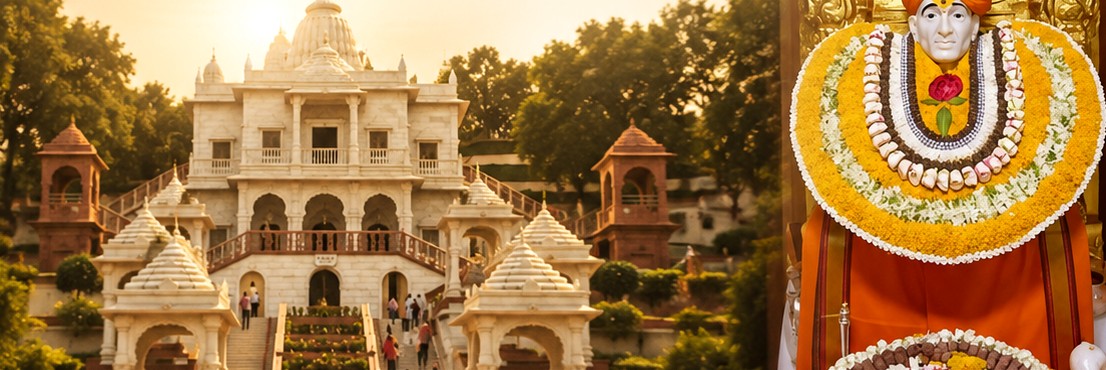
Sandipani Ashram in Ujjain is one of the most beloved sacred memories in Hindu tradition — the gurukula where, according to tradition, the young Krishna, his brother Balaram and his devoted friend Sudama studied under Guru Sandipani in the ancient city of Avantika. Standing in its quiet courtyard beside the Gomti Kund, far from the roar of the Mahakaleshwar crowds, pilgrims find one of the gentlest and most human corners of Ujjain.
The Tradition of Krishna’s Gurukula
The Bhagavata tradition recounts that Krishna and Balaram, as boys, were sent from Mathura to Avantika — today’s Ujjain — to study at the hermitage of Guru Sandipani. Here the divine brothers lived as ordinary students: gathering firewood, tending cattle, serving their teacher and mastering the sciences and arts of the age. Tradition lovingly records that Krishna grasped sixty-four arts in an exceptionally short span, astonishing his guru.
What draws devotees most, perhaps, is the picture of the Lord of the Universe sitting at a teacher’s feet — an image that has made Sandipani Ashram a byword for guru-bhakti, reverence for the teacher. The friendship of Krishna and the poor brahmachari Sudama, forged in these classrooms and later immortalised in the story of Sudama’s humble gift of flattened rice, is held to have begun here as well. These accounts belong to tradition and the Puranas, and generations of teachers at Ujjain have retold them at this very spot; details of the sage’s lineage belong to tradition rather than recorded history, which the ashram’s own guides narrate with evident love. School groups and students of Sanskrit visit through the day, and the sound of their recitations drifting across the water is a fitting soundtrack to a site devoted to learning.
Guru Dakshana — The Lost Son
No account of the ashram is complete without the story of the guru’s dakshana, the offering a student makes at the end of study. According to tradition, Sandipani asked only for the return of his son, who had drowned in the ocean near Prabhasa. Krishna and Balaram journeyed to the sea and, tradition says, retrieved the boy alive from the waters and the demon’s hold beneath them. The guru, overjoyed, blessed his students with the fullest fruits of learning. The tale is retold to this day as the supreme example of a disciple’s debt repaid.
Gomti Kund
At the heart of the ashram lies the Gomti Kund, the tank whose waters are central to its sanctity. According to tradition, out of compassion for the guru’s household — who had to walk far for water — Krishna summoned the waters of the holy rivers, including the Gomti, to gather in this one kund. Local belief holds that the kund has never gone dry, and pilgrims reverently sprinkle its water or sit awhile on its steps. Around the precinct you will also find a small shrine with images of Guru Sandipani with Krishna and Balaram, and spots pointed out by tradition as the places where the students sat and studied.
Many families come here for their children’s vidyarambh — the ceremony of first letters — believing that learning begun where Krishna studied carries a special blessing. Watching a small child guided through the alphabet on a slate, with the kund glinting behind, is among the tenderest sights in all of Ujjain.
Visiting the Ashram Today
| Quick fact | Detail (approximate) |
|---|---|
| Location | Old Ujjain, within the city |
| Distance from Mahakaleshwar | Roughly 3–5 km, a short drive |
| Key sights | Gomti Kund, Guru Sandipani shrine, traditional study spots |
| Typical timings | Daytime hours, commonly morning to evening with a possible midday break |
| Best combined with | Mahakaleshwar darshan, Mahakal Lok walk, Ram Ghat evening aarti |
The ashram is compact and can be seen at an unhurried pace in well under an hour. Timings change, so confirm locally; mornings are quiet and pleasant. There is no elaborate queue system here — just the tank, the shrine and the layered stillness of a very old story. A short parikrama of the kund is customary for those who wish, and a small counter near the gate sells offerings. The surrounding old-quarter lanes, with their little shrines and pathshalas, still carry something of a gurukul neighbourhood’s calm — worth a few unhurried minutes on foot.
A Quiet Contrast to the Great Shrines
Ujjain’s great experiences — the Bhasma Aarti, the Mahakal Lok corridor, the Ram Ghat aarti — are grand and overwhelming by design. Sandipani Ashram offers the opposite note: a place to remember that this city also nurtured a boy student, a teacher’s love and a friendship that death itself did not end. Pilgrims who pair the mighty history of the Mahakaleshwar Jyotirlinga with this humble gurukula leave with a fuller sense of Avantika’s range — the city of Time’s Lord and of a divine childhood alike. Similarly layered traditions illuminate our account of Omkareshwar’s history and spiritual significance at the sister Jyotirlinga on the Narmada.
Summary
Sandipani Ashram preserves the tender tradition of Krishna, Balaram and Sudama at their guru’s feet in ancient Avantika — the story of the guru dakshana, the miracle of the Gomti Kund, and the ideal of reverence for the teacher. Roughly 3–5 km from Mahakaleshwar, it asks for less than an hour of your day and rewards it with the quietest, most human moment in Ujjain. Visit in the morning, confirm timings locally, and let the boyhood of the Lord complete what the darshan of Mahakal began.
Frequently Asked Questions
Where did Krishna study as a child?
According to tradition, young Krishna, along with his brother Balaram and friend Sudama, studied at the ashram of Guru Sandipani in Ujjain, then known as Avantika. The Sandipani Ashram with its Gomti Kund stands at the site honoured by this tradition.
What is Gomti Kund at Sandipani Ashram?
Gomti Kund is the sacred water tank at the ashram. According to tradition, Krishna arranged for the waters of holy rivers, including the Gomti, to gather here so his guru's household would not have to travel far for water. Devotees revere the kund, which local belief holds never dries.
How far is Sandipani Ashram from Mahakaleshwar temple?
The ashram lies a short drive from the Mahakaleshwar temple, commonly estimated at roughly 3–5 km within old Ujjain. It is an easy addition to any temple itinerary in the city.