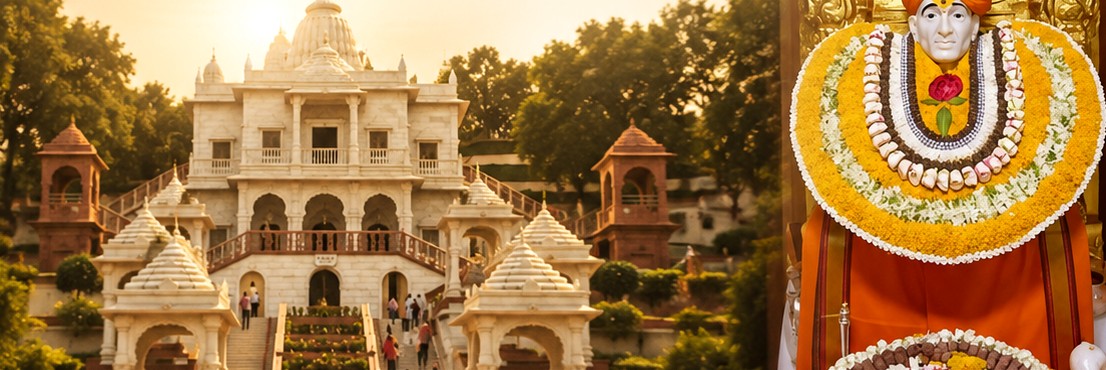
Most first-time visitors to Pandharpur are surprised to learn that Rukmini Devi, the divine consort of Vitthal, has her own separate shrine away from the main sanctum — and that pilgrims deliberately visit it as part of their darshan plan. The Rukmini temple Pandharpur pilgrims know today is small in size but immense in feeling: a shrine wrapped in legend, maternal grace and the gentle politics of a family quarrel among the gods. This guide covers the shrine’s history and traditions, the legend of separation as it is told, the custom of visiting Rukmini first, and the practical details that help you fold her temple naturally into your pilgrimage.
Rukmini’s Separate Abode
At the great Vitthal-Rukmini Mandir — described in detail in our Pandharpur Vitthal darshan guide — the sanctum belongs to Vitthal standing on his brick. Rukmini, whom tradition honours as an incarnation of Lakshmi and the chief consort of Krishna, is not beside him in that sanctum; her temple stands a short walk away in the old town, near the river quarter. The two shrines are visited as one pilgrimage, and the walk between them has been polished smooth by centuries of devotees making the same little journey.
The separation itself is the shrine’s signature. In most large Krishna temples of India, the Lord and his consort share a sanctum; at Pandharpur, uniquely, the divine couple reside apart, and the whole town’s darshan culture has grown around that arrangement. Devotees do not read the separation as estrangement but as an invitation — two doors of the same house of grace.
The Legend of Separation, According to Tradition
According to one traditional account preserved in Pandharpur’s oral lore, a misunderstanding arose between the divine couple after the Lord, utterly given to his devotees, neglected a vow or courtesy owed to Rukmini. In her displeasure — which the tradition portrays not as human pettiness but as the dignity of divine Shakti — Rukmini withdrew and resided apart from him at this spot, absorbed in her own devotion. Versions of the story differ in detail, and the temple’s own telling is the most authoritative; pilgrims will hear several gentle variations from pujaris and elderly warkaris alike.
What the tradition agrees upon is the meaning drawn from it: that the Lord of Pandharpur, who waits patiently on his brick for every devotee, himself honours the distance his consort chose, and that no devotee’s darshan of him is complete without first bowing to her. The legend thus turns a geography lesson — two temples, one town — into a lesson in reverence: love of the Lord includes honour to his beloved.
Why Devotees Seek Rukmini’s Darshan First
The beloved custom is to take Rukmini’s darshan before Vitthal’s. The reasoning, as devotees explain it, is tender and practical in equal measure: Rukmini is the Mother of the house, and a guest greets the mistress of the house before meeting its Lord, so that she herself welcomes the devotee into her husband’s presence. Many warkaris complete the arc by returning to her shrine once more after the main darshan, a gesture of gratitude before leaving town.
Elderly women devotees in particular speak of Rukmini as the one who listens — the shrine where matters of family, marriage and household worry are quietly placed before the Mother. During the yatra season, streams of warkaris, fresh from their bath in the Chandrabhaga — whose significance is woven through the whole town, as our Chandrabhaga river guide describes — pass through her doorway in an unhurried line, standing before her for a few unhurried seconds that many describe as the softest darshan of their pilgrimage.
What to See at the Shrine
- The sanctum and idol. Rukmini Devi’s image is adorned in the sari and ornaments offered by devotees over generations; the decoration changes with festivals and the lunar calendar.
- The quiet courtyard. Compared with the vast energy of the main temple, Rukmini’s shrine offers a smaller, softer enclosure where one can actually stand still — many pilgrims use it for a few minutes of prayer and rest between the river and the great darshan queue.
- The walk between the shrines. The lane connecting the two temples is lined with small shops selling puja items, tulsi malas, pedha offerings and pictures of the saints; it is part of the experience rather than an obstacle to it.
- Festival evenings. On ekadashi days and during the Ashadhi and Kartiki yatras, the shrine is decorated and the crowds flow continuously; the evening aarti here is intimate enough to be felt rather than merely seen.
Timings and Practical Tips
| Item | Indicative detail |
|---|---|
| Opening | Traditionally early morning, in step with the main temple |
| Midday break | An afternoon closure is generally observed, as at the main mandir |
| Evening darshan | The shrine reopens for the evening aarti period |
| Best time to visit | Early morning after the Chandrabhaga snan, or late evening |
| Crowds | Heaviest on ekadashi days and during the Ashadhi and Kartiki yatras |
All timings are approximate and vary with the ritual calendar — confirm with temple authorities as schedules change. As at the main temple, leave footwear and phones at the designated counters, dress modestly, and expect to surrender photographs at the door; the memory of Rukmini’s quiet sanctum survives without them.
Summary
The Rukmini temple gives Pandharpur its most tender lesson: that in this tirtha even the Lord honours his beloved’s chosen space, and that the devotee’s path runs through her door. Visit her shrine first — ideally at dawn, after the river bath — and again after Vitthal’s darshan, and let the short walk between the two temples become part of your prayer rather than mere transit. Hear the legend of separation in whichever version the town tells you, with the reverence tradition asks. And when you finally stand before Vitthal, you will do so, according to the old custom, as someone the Mother of the house has already welcomed — with her blessing resting on your darshan like a hand on your shoulder.
Frequently Asked Questions
Where is the Rukmini temple in Pandharpur?
Rukmini Devi's shrine stands a short walk from the main Vitthal-Rukmini Mandir, in the old temple quarter near the river. It is a separate temple, and devotees typically visit both shrines in a single pilgrimage circuit.
Why do devotees visit Rukmini's shrine first?
According to local custom, devotees take Rukmini Devi's blessings before standing before Vitthal, seeking the Mother's grace so that the Lord's darshan is complete. Many also return to her shrine after the main darshan before leaving the town.
What is the legend behind Rukmini's separate shrine?
According to one traditional account, Rukmini resided apart from the Lord at this spot after a misunderstanding arose between them, and she remained here in quiet devotion. The story is part of Pandharpur's oral tradition and is retold in several versions.
What are the darshan timings at the Rukmini temple?
The shrine broadly follows the rhythm of the main temple, opening early, closing for a midday break and reopening in the evening. Exact timings vary with festivals and the lunar calendar, so confirm with temple authorities as schedules change.