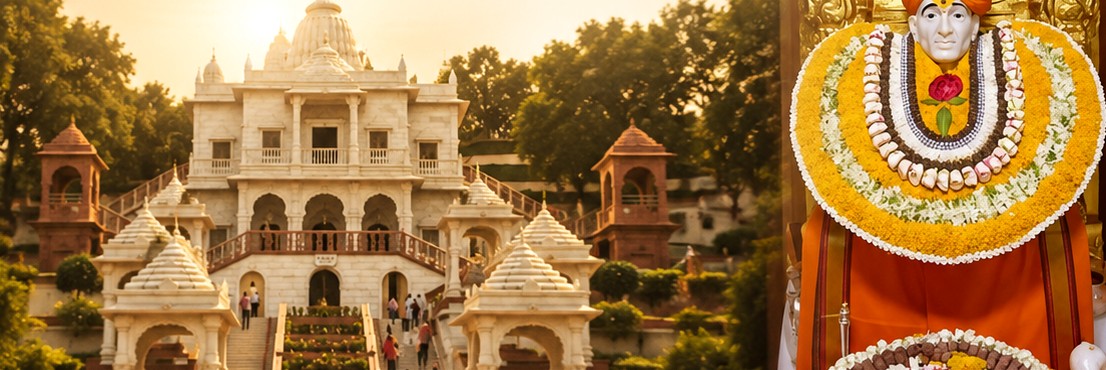
Every great pilgrimage town in Maharashtra carries a story, but few carry one as beloved as Panchavati, Nashik — the sacred quarter on the Godavari where, according to tradition, Lord Rama, Sita and Lakshmana lived during their years of forest exile. Within a compact, walkable area stand the black-stone Kalaram Mandir, the holy tank of Ram Kund, the quiet cave of Sita Gufa, the Nandi-less Kapaleshwar shrine and other sacred sites. This guide walks you through each place, its significance, a practical walking route, and visitor tips — the essential half-day complement to a Trimbakeshwar pilgrimage.
Panchavati and the Ramayana
According to tradition, during the vanvas — the exile period recounted in the Ramayana — Rama chose this bend of the Godavari for his dwelling, beside a grove of five great banyan trees, from which the name Panchavati derives. It was from here, tradition holds, that the demon Shurpanakha’s episode unfolded, setting in motion the chain of events leading to the abduction of Sita. For devotees, this gives Nashik an intimate quality: not the grandeur of Ayodhya, but the humbler sanctity of the place where the Lord lived simply, among trees and beside a river.
Panchavati sits on the left (north) bank of the Godavari at Nashik; the river here flows unusually northward for a short stretch, a detail pilgrims love to note.
Kalaram Mandir
The spiritual heart of Panchavati is the Kalaram Mandir — the “temple of the black Rama.” The sanctum enshrines Lord Rama in black stone, flanked by Sita and Lakshmana, and Hanuman facing his Lord. According to tradition, the temple’s construction in the late eighteenth century followed a dream in which the shrine’s patron was guided to an ancient image of Rama buried nearby; the temple was subsequently built in black basalt to honour the black (kala) deity.
Visitors notice several distinctive features:
- The black stone architecture, echoing the solemn Deccan style seen also at Trimbakeshwar.
- The large courtyard, with a deep-sthana and an ancient Audumbar tree associated with tradition.
- The temple’s role in modern history — the courtyard witnessed a landmark satyagraha for temple entry in the 1930s, a fact commemorated locally.
The temple typically opens in the early morning and closes in the night with an afternoon break; timings shift with the lunar calendar, so confirm locally. Morning hours are calm and recommended.
Ram Kund and the Godavari
A short walk away lies Ram Kund, the most revered bathing tank on the Godavari at Nashik. According to tradition, Lord Rama bathed here during his stay, and the tank has drawn pilgrims for centuries. Its waters are considered especially sacred for offering pinda-dan to ancestors, and during the Kumbh Mela, Ram Kund becomes the epicentre of the shahi snan — the royal bath. Ashes of many revered national figures have, by tradition, been immersed here.
Devotees typically spend 20–30 minutes at the ghat: a sprinkling of the river’s water, a quiet prayer, and time to watch the river life around. Modest dress is expected, and small changing areas exist near the ghats for those taking a dip.
Sita Gufa, Kapaleshwar and Other Sacred Sites
Sita Gufa. A narrow, low cave near Kalaram Mandir, honoured as the place where Sita is said to have resided and worshipped Shiva. Devotees bend low to enter — a physical humility that pilgrims often describe as the point. Idols of Rama, Sita and Lakshmana, and a small Shiva shrine, stand within.
Kapaleshwar Mandir. A short walk from Ram Kund, this is among the oldest Shiva shrines of Nashik. Its local distinction: by tradition, it has no Nandi facing the sanctum — an unusual absence explained by the shrine’s own legend concerning Shiva and a curse. Devotees of Shiva will feel the quiet pull of this small, ancient temple.
Other sites within easy reach include Sundarnarayan Mandir with its exquisite carvings, Tapovan, the riverside stretch associated with the sages’ meditation, and Gora Ram Mandir — together, a dense cluster of sacred geography.
A Walking Route Through Panchavati
The sites above sit within roughly 1–2 km of one another. The table below offers a comfortable sequence; times include darshan and short pauses.
| Order | Site | Approx. Time | Notes |
|---|---|---|---|
| 1 | Kalaram Mandir | 30–45 min | Start early morning for calm darshan |
| 2 | Sita Gufa | 15–20 min | Narrow entry; go one at a time |
| 3 | Ram Kund ghat | 30–45 min | Dip or pinda-dan; ghats are busy at sunrise |
| 4 | Kapaleshwar Mandir | 20–30 min | Quiet, ancient Shiva shrine |
| 5 | Sundarnarayan / Tapovan | 30–40 min | Optional extensions if time allows |
Allow approximately 3–4 hours for the full circuit at an unhurried, devotional pace. Auto-rickshaws ply the area for those who prefer not to walk between sites.
Visitor Tips
- Best hours. Early morning (approximately 6:00–9:00 AM) combines pleasant weather, softer crowds and active temple life; evening is lively with aarti sounds across the quarter.
- Dress and conduct. Traditional attire is appreciated at all temples; footwear is left outside each shrine.
- Festival seasons. Ram Navami and the Kumbh transform the area — rewarding for devotees, demanding for schedules. The history and practicalities of the festival are covered in our Nashik Kumbh Mela guide.
- Combining with Trimbakeshwar. Panchavati pairs naturally with a Trimbak visit, about 30 km away; see our Nashik to Trimbakeshwar travel guide for the connection.
- River comparisons. Pilgrims who have walked the ghats of Omkareshwar will find the Godavari’s banks busier and more urban; the Narmada’s island ghats, described in our piece on the sacred ghats of Omkareshwar, offer a contrasting quietude.
Summary
Panchavati, Nashik compresses the Ramayana’s exile years into a single walkable sacred quarter: the black-stone Kalaram Mandir, the pilgrimage-worn steps of Ram Kund, the humble bow of Sita Gufa, the Nandi-less Kapaleshwar, and the river Godavari binding them all. Half a day suffices; early morning is best; and the whole circuit sits just approximately 30 km from the Trimbakeshwar Jyotirlinga, making Nashik one of Maharashtra’s most rewarding pilgrimage bases. Walk slowly, confirm temple timings locally as schedules change, and let the tradition of Rama’s forest dwelling settle over you like the shade of the five banyans themselves.
Frequently Asked Questions
How much time is needed to see Panchavati in Nashik?
Most of Panchavati's main sites — Kalaram Mandir, Ram Kund, Sita Gufa and Kapaleshwar — lie within walking distance of each other and can be covered comfortably in about half a day at an unhurried pace, including a dip or quiet time at Ram Kund.
Why is the area called Panchavati?
According to tradition, the name comes from five great banyan (vat) trees under which Lord Rama, Sita and Lakshmana are said to have stayed during their forest exile. The site has been revered for centuries on this account.
Can Panchavati and Trimbakeshwar be combined in one day?
Yes. Trimbak lies approximately 30 km from Nashik, so a common plan is Panchavati darshan in the morning followed by an afternoon visit to the Trimbakeshwar Jyotirlinga, or an early Trimbak start with Panchavati in the evening.