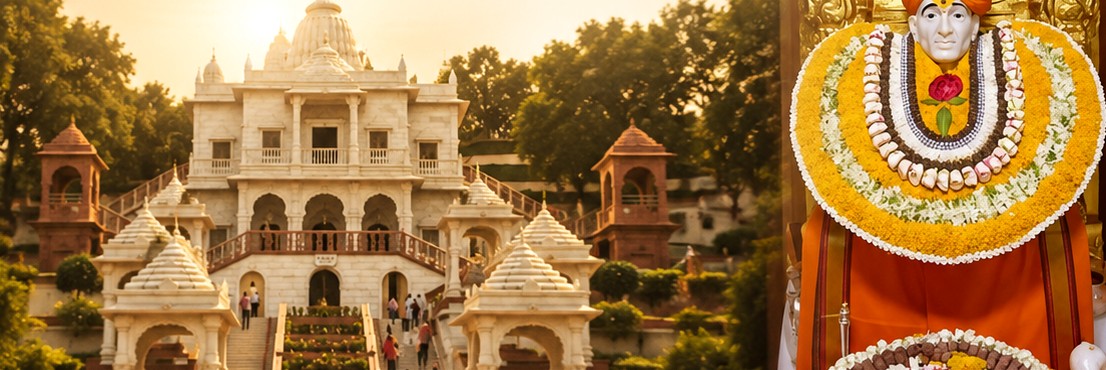
For centuries, the last stretch of the journey to Kashi Vishwanath was a squeeze through narrow lanes — atmospheric, certainly, but exhausting for elderly pilgrims and perilous in festival crowds. The Kashi Vishwanath Dham corridor changed that almost overnight. Inaugurated in December 2021 and in full public use through 2022, the project rebuilt the space between the temple and the Ganga into a grand sandstone complex. This guide explains what changed, what facilities the Dham now offers, how the darshan flow works, and where the best viewpoints are.
What the Corridor Changed
The essential fact is simple: the temple now meets the river directly. Before the project, the sanctum and the nearest ghat were separated by a dense web of old-city buildings, and the temple itself sat hemmed in, its golden spire barely visible. The corridor cleared and rebuilt approximately 400,000 square feet of space — figures reported at the time of construction — creating a processional route from the Ganga (primarily Lalita Ghat) to the Vishwanath complex, with the temple suddenly given room to breathe.
Three changes matter most to pilgrims. First, accessibility: the elderly, wheelchairs, and families with children can now approach the sanctum along level, well-managed walkways. Second, capacity: festival crowds that once jammed the lanes are distributed across open plazas with organised queues. Third, the return of the temple’s riverfront: for the first time in living memory, a devotee standing at the sanctum can walk to the Ganga in a few minutes — restoring, in a modern idiom, the ancient bond between Kashi’s lord and Kashi’s river described in our Kashi Vishwanath darshan guide.
Facilities at the Dham
The Dham is now closer to a well-designed pilgrimage campus than a single temple. Indicative facilities include:
| Facility | What to Expect |
|---|---|
| Queue complexes | Covered, segmented waiting halls for free and passholder lines |
| Lockers and cloakrooms | Deposit points for mobile phones, cameras and bags, which are barred inside |
| Prasad and food counters | Temple-run prasad counters plus food courts and drinking water |
| Restrooms and amenities | Public conveniences, seating, shaded rest areas |
| Assistance | Wheelchair support and help desks for elderly and differently-abled pilgrims |
| Ghat connectivity | Direct sandstone steps down to Lalita Ghat and the neighbouring ghats |
Availability and locations of services are adjusted from time to time, so check with the trust’s information counters on arrival.
How the Darshan Flow Works Now
The corridor did not change the temple’s ritual rhythm — the Mangala, Bhog, Sandhya and Shayan aartis continue per the current system, and all timings should be confirmed with temple authorities as schedules change — but it completely changed how devotees move. Visitors enter through security checkpoints at the corridor entrance, deposit prohibited items at the lockers, and join either the free darshan queue or the paid-darshan line depending on the pass they hold. The queues converge through sanitised, marshalled halls rather than street jams, and after darshan, pilgrims can exit toward the ghats instead of doubling back through the lanes.
Practical suggestions for a smooth flow:
- Go early: the pre-dawn hours remain the least crowded, as detailed in our darshan and aarti guide for Kashi Vishwanath.
- Travel light: the fewer items you carry, the faster your screening.
- Book aarti passes in advance where online options are open; pass rates and quotas change, so confirm at booking.
- Allow buffer time on Mondays, Shravan and festival days, when even the new capacity is tested.
Photography and Viewpoints
The Dham has quietly become one of north India’s most photographed sacred spaces — within limits. In the open plazas and along the corridor, photography of the architecture is generally acceptable, and two views in particular reward the patient: the golden spire of Vishwanath rising above the sandstone colonnades, best in early light, and the sweep of steps descending to the Ganga at the river end of the corridor, where the temple and the river finally meet in one frame. Inside the sanctum, photography is strictly prohibited, and devices should be deposited before entering. Once you descend to the river, the whole world of the Varanasi ghats opens up — from the aarti lamps of Dashashwamedh to the dawn boatmen, all within a short walk.
A Parallel Transformation — Mahakal Lok in Ujjain
Varanasi is not alone in this era of temple-town renewal. In Ujjain, the Mahakal Lok corridor has similarly reimagined the approach to the Mahakaleshwar Jyotirlinga — sculpted colonnades, illuminated public spaces and eased circulation around one of India’s most ancient shrines, as covered in our guide to Ujjain’s Mahakal Lok. For devotees travelling between the Jyotirlingas — from Mahakaleshwar to Omkareshwar on the Narmada, and onward to Kashi — these projects share one philosophy: honouring the sanctity of the ancient while mercifully updating the pilgrim’s path. The old lanes of Varanasi still exist, still beloved; but now the mountain, in a sense, has come to Mahadev’s door.
Summary
The Kashi Vishwanath Dham corridor represents the most significant change to India’s most famous Shiva temple in centuries — a direct, dignified passage between the Ganga and the sanctum, with queue halls, lockers, assistance and amenities that make the yatra feasible for pilgrims of every age. Enter early, deposit your devices, follow the flow from ghat to sanctum, and photograph only where permitted. Combined with darshan itself and an evening at the ghats, the corridor has turned a demanding pilgrimage into a graceful one — a modern gateway worthy of the Lord of Kashi.
Frequently Asked Questions
When did the Kashi Vishwanath Dham corridor open?
The corridor was inaugurated in December 2021 and came into full public use through 2022, so most visitors know it simply as the 2022 transformation. It connects the Kashi Vishwanath temple directly to the Ganga, primarily at Lalita Ghat.
Can visitors walk from the ghats to the temple through the corridor?
Yes. The corridor links the temple complex to the riverfront, allowing pilgrims to move between the Ganga and the sanctum in a few minutes — a journey that once involved negotiating narrow, crowded lanes. The route is broad, level and security-checked.
Is photography allowed in the Kashi Vishwanath corridor?
Photography is generally permitted in the open corridor and courtyard areas, but it is strictly prohibited inside the sanctum and near screening points. Follow the signage and the instructions of temple staff and security personnel at all times.