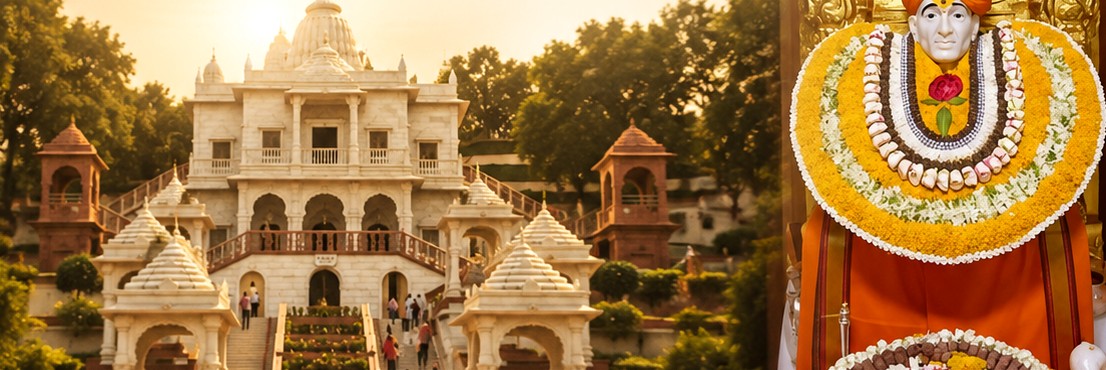
For devotees who have been told there is Kalsarp Yog in their horoscope, the name Trimbakeshwar usually follows within the same breath. This Jyotirlinga at the source of the Godavari is, by long tradition, the seat of the Kalsarp (Kalsarpa) puja — the remedy most widely prescribed and sought for this planetary condition. This complete guide explains what Kalsarp Yog means in astrological tradition, why Trimbakeshwar became its traditional home, how the one-day vidhi unfolds, what it costs, and how to book responsibly without falling prey to fear-driven marketing.
What Is Kalsarp Yog?
In Vedic astrology (jyotisha), Kalsarp Yog (also spelled Kalsarpa Yog or dosha) is said to occur in a birth chart when all seven grahas — the Sun, Moon, Mars, Mercury, Jupiter, Venus and Saturn — are hemmed between the shadow planets Rahu and Ketu. The name evokes the serpent: kal (time) and sarpa (serpent), with Rahu and Ketu visualised as the head and tail of a great celestial snake coiled around the chart.
According to tradition, depending on the positions involved, the condition is associated with experiences such as:
- Repeated obstacles in career, business or education despite sincere effort
- Delays in marriage or family happiness
- Episodes of sudden anxiety, disturbed sleep or unexplained fears
- A general sense of plans stalling just before completion
It is important to hold this gently. Astrology itself teaches that no single yog defines a life; charts are read as wholes, and Kalsarp Yog is considered by many tradition-honouring astrologers to be one influence among many — one that also appears, by some readings, in the charts of remarkably accomplished people. The traditional advice is proportionate: understand the condition, perform the prescribed remedy with faith, and live one’s dharma with steady effort. Fear is not part of the remedy.
Why Trimbakeshwar Is the Traditional Seat
According to tradition, Trimbakeshwar is the prescribed and most complete location for the Kalsarp puja. Several reasons are given. The presiding deity here is the three-faced Jyotirlinga embodying the Trimurti, and Rahu–Ketu worship is traditionally linked with Shiva’s grace at this shrine. The vidhi is anchored to the Kushavarta tirtha, where the Godavari — the Dakshin Ganga — gathers after descending Brahmagiri hill; ritual bathing in her waters forms the opening of the puja. And the hereditary priest families of Trimbak, addressed as guruji, have transmitted the specialized vidhi through generations.
The result is a living tradition: on any given day at Kushavarta, one finds families from Gujarat to Bengal standing waist-deep in the kund’s water, mantra rising from the stone steps. An orientation to the shrine itself is in our complete Trimbakeshwar Jyotirlinga darshan guide.
The One-Day Puja Process
The Kalsarp vidhi at Trimbakeshwar is traditionally completed in a single day. The sequence below reflects the commonly followed outline; your guruji will guide the exact details, and times are indicative.
| Stage | What Happens | Approx. Timing |
|---|---|---|
| Sankalp | Declaration of name, gotra and purpose before the guruji | Early morning |
| Kushavarta snan | Ritual bath in the kund by the devotee(s) | Morning |
| Rahu–Ketu worship | Kalash sthapana, invocation, and offerings to Rahu and Ketu with prescribed mantras | Mid-morning to afternoon |
| Rudrabhishek / Shiva darshan | Worship of the Jyotirlinga; darshan of the three-faced linga | Afternoon |
| Homa and conclusion | Fire offerings, donations (dana) and final blessings | Late afternoon |
Practical customs to know:
- Dress simply. Traditional attire — dhoti or saree as appropriate — is customary for the ritual bath and puja.
- Fasting. Many devotees observe a light fast until the vidhi concludes, taking only water or fruit.
- Donations. The vidhi traditionally concludes with dana — grain, food, clothing or feeding of the needy — given according to means. This is separate from the guruji’s dakshina.
- Couples and families. The puja is commonly performed by the affected person, with spouse or family joining; ask your guruji in advance about who should participate.
Indicative Cost and Booking Responsibly
Cost. Reported charges vary with the priest family and the scale of the vidhi. As a hedged indication, pilgrims most often describe totals in the range of approximately ₹5,000 to ₹15,000, covering ritual materials and dakshina; elaborate arrangements or additional pujas cost more. Stay, food and travel are extra. Treat every figure as indicative only — confirm the full cost and its breakdown at booking, before you travel.
Booking. The vidhi is arranged directly with local priest families, ideally weeks in advance and earlier still around festival periods. Practical guidance for booking well:
- Book through established channels or trusted referrals — reputable trust accommodation, or family who has performed the vidhi — rather than agents who approach you at the bus stand or online with aggressive promises.
- Ask clearly: who performs the vidhi, what is included, what is extra, and what donations are expected.
- Be suspicious of fear. A guruji worthy of the name explains the tradition calmly; be wary of anyone who insists on escalating costs through alarm.
A Note of Balance
Pilgrims should also know that Kalsarp puja and Narayan Nagbali are different rituals. Some families are advised to perform both — Narayan Nagbali for ancestral peace, Kalsarp for the Rahu–Ketu condition — and Trimbakeshwar is the traditional seat of each. The three-day ancestral vidhi is explained in our separate Narayan Nagbali guide; if you have been advised toward both, plan your itinerary and leave accordingly. Above all, hold the remedy in proportion: the tradition itself teaches that puja strengthens the devotee, and it is the strengthened devotee — patient, effortful, surrendered — who transforms a life.
Summary
The Kalsarp Yog puja at Trimbakeshwar is a one-day Vedic ritual for the Rahu–Ketu planetary condition described in jyotisha, performed by hereditary priest families at the Kushavarta tirtha under the grace of the three-faced Jyotirlinga. The day moves from sankalp and ritual bathing through Rahu–Ketu worship and Shiva darshan to a concluding homa and dana. Indicative costs run approximately ₹5,000–₹15,000, always to be confirmed at booking, and reservations are best made in advance through established channels. Approached with faith rather than fear, the vidhi is traditionally believed to soften obstacles and restore steadiness — one more gift of the Godavari’s sacred source.
Frequently Asked Questions
How long does Kalsarp puja at Trimbakeshwar take?
The traditional Kalsarp vidhi at Trimbakeshwar is completed in a single day, usually beginning in the morning at the Kushavarta tirtha and concluding by afternoon or evening. Most devotees stay one to two nights in Trimbak to allow an unhurried schedule.
What is the cost of Kalsarp puja at Trimbakeshwar?
Indicative charges reported by pilgrims generally fall between approximately ₹5,000 and ₹15,000 depending on the priest family and the scale of the ritual, exclusive of stay and travel. Costs vary and must be confirmed at booking.
Is Kalsarp puja different from Narayan Nagbali?
Yes. Kalsarp puja is a one-day ritual addressed to Rahu and Ketu for Kalsarp Yog in a horoscope, while Narayan Nagbali is a three-day ancestral and atonement vidhi. Both are traditional at Trimbakeshwar and some families perform them on separate visits.