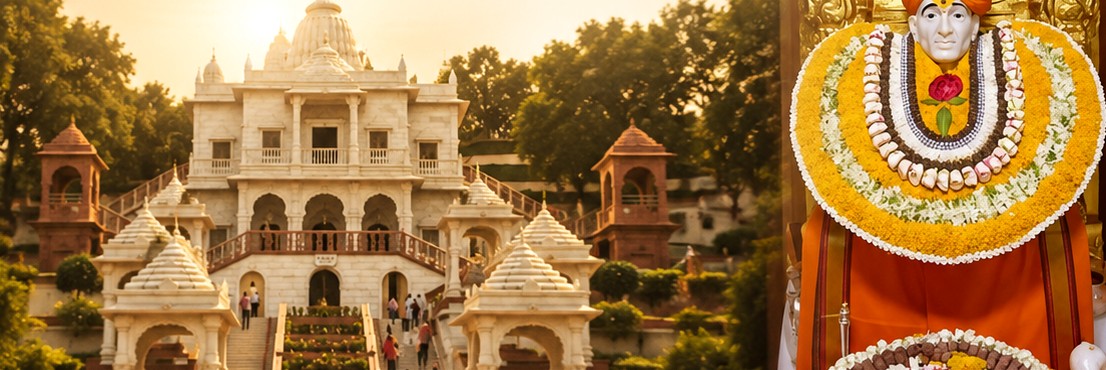
The Panchkosi Narmada parikrama is a traditional shorter ritual circumambulation that allows pilgrims to experience the merit of a Narmada parikrama without committing to the full, months-long river yatra. Rooted in the ancient practice of measuring sacred journeys in kos (a traditional Indian unit of distance), the Panchkosi — literally “five kos” — is a localized circuit around a sacred zone associated with the Narmada. This guide explains its significance, the approximate distance, how pilgrims perform it, and how it differs from the other parikramas at Omkareshwar.
What Is the Panchkosi Parikrama?
The word Panchkosi (or Panchkroshi) means “five kos.” A kos is a traditional Indian measure of distance, roughly equivalent to about 3 to 4 kilometres, though the exact value varies by region and era. The Panchkosi parikrama is therefore a circuit whose traditional length is described as five kos — a deliberate, sacred circumference rather than an arbitrary walk.
Such Panchkosi circuits exist at several holy places across India, including Kashi (Varanasi) and Ayodhya, always marking out a sacred zone around the central shrine or river. In the Narmada context, the Panchkosi parikrama represents a concentrated form of the great river circumambulation — a way to honour the goddess Narmada within a manageable, bounded circuit.
Significance of the Shorter Circuit
For devotees who cannot undertake the full Narmada parikrama of approximately 2,600 km and several months, the Panchkosi parikrama offers a deeply meaningful alternative. It is believed that walking this shorter circuit with devotion earns a portion of the same spiritual merit (punya) as the complete yatra.
The significance lies not in the distance but in the intention and discipline. Pilgrims approach the Panchkosi with many of the same vows as the full parikrama — simplicity, restraint, reverence for the river — condensed into a journey of a day or two. It is especially popular among families, elderly devotees, and working professionals who yearn for the parikrama experience but have limited time.
Approximate Distance and Time
| Parameter | Detail |
|---|---|
| Traditional length | “Five kos” (~5 kos) |
| Approximate circumference | ~15 to 20 km (indicative) |
| Typical duration | 1 day (long day) to 2 days |
| Difficulty | Moderate; mostly walkable paths |
| Best time | October to March; start at dawn |
The exact route and distance can vary by local tradition and the specific sacred zone being circumambulated, so treat these figures as indicative. Some communities complete the circuit in a single long day; others break it across two days with an overnight rest.
How Pilgrims Perform the Panchkosi Parikrama
The practice follows a reverent, structured rhythm.
1. Preparation and Sankalpa
Before setting out, pilgrims bathe, wear clean simple clothing, and make a sankalpa — a formal vow stating their intention to perform the parikrama for the welfare of themselves and their family. This vow-setting is central to all Hindu pilgrimages and marks the difference between a “walk” and a “yatra.”
2. Beginning the Circuit
The parikrama is traditionally begun in the early morning, often before sunrise, to take advantage of cool air and to align with the spiritual potency of the brahma muhurta (the pre-dawn hour considered most auspicious).
3. Walking the Route
Pilgrims walk clockwise around the sacred zone, keeping the central shrines and the Narmada to their right. The route typically passes:
- Temple complexes and shrines where pilgrims pause for darshan.
- Riverbank stretches where the Narmada comes into view.
- Villages and ashrams that offer water, prasad, and rest.
- Sacred trees and kunds (ponds) of local significance.
4. Rest and Sustenance
Many pilgrims observe a fast or eat only simple food offered along the way. Light refreshments — fruit, water, and tea — are typically available from small stalls and ashrams on the route. Carrying your own water is wise.
5. Completion
The circuit concludes where it began, with a final prayer, offering, or puja. This closure is important — it “seals” the merit of the parikrama and expresses gratitude to the Narmada.
How It Differs from Other Parikramas
It is important to distinguish the Panchkosi from the other sacred walks at Omkareshwar. The table below clarifies the differences.
| Parikrama | Distance | Duration | Scope |
|---|---|---|---|
| Omkareshwar island parikrama | ~5 to 8 km | A few hours | Around the Om-shaped island |
| Panchkosi parikrama | ~15 to 20 km | 1 to 2 days | A wider sacred zone around the area |
| Full Narmada parikrama | ~2,600 km | 3 to 6 months | The entire river, both banks |
The island parikrama is the shortest and most intimate — a loop around the island itself. The Panchkosi is broader, encompassing a defined sacred zone beyond the island. The full Narmada parikrama is the great lifetime yatra along the whole river. For the complete river journey, see our full Narmada parikrama guide; for the island loop, see the Omkareshwar parikrama route guide.
Practical Tips for the Panchkosi
To make the most of the shorter circuit:
- Start early — dawn walks are cooler, quieter, and more auspicious.
- Wear easy-to-remove footwear — you will enter several temples en route.
- Carry water and light snacks — though prasad is often available, self-sufficiency helps.
- Walk at a meditative pace — the parikrama is devotion, not a race.
- Respect local customs — some stretches pass through villages where modest dress and quiet conduct are appreciated.
- Travel in a small group — especially comforting for elderly pilgrims and women travelling alone.
Who Should Choose the Panchkosi
The Panchkosi parikrama is ideal for:
- Families with children or elderly members who want a meaningful but achievable yatra.
- Working professionals with only a few days to spare.
- First-time pilgrims sampling the parikrama tradition before a longer commitment.
- Devotees returning year after year as a regular practice of devotion.
It offers the structure and dignity of a full parikrama in a form that fits within modern life.
A Bridge to the Greater Yatra
Many who complete the Panchkosi feel a quiet call toward the full Narmada parikrama later in life. The shorter circuit serves as both a complete offering in itself and a preparation for the greater journey. Either way, the act of walking with the Narmada — even for a single day — leaves a lasting imprint on the heart.
Summary
The Panchkosi Narmada parikrama is a traditional shorter ritual circumambulation of about 15 to 20 km around a sacred zone, typically completed in one to two days. It allows devotees who cannot undertake the full ~2,600 km river parikrama to still earn meaningful merit through a focused, reverent circuit. Performed with a sankalpa at dawn, walked clockwise past temples and riverbanks, and concluded with gratitude, the Panchkosi is a beautiful bridge between the short island parikrama and the great lifetime yatra along the entire Narmada.
Frequently Asked Questions
What is the Panchkosi Narmada parikrama?
The Panchkosi (also called Panchkroshi) parikrama is a traditional shorter ritual circumambulation around a sacred zone associated with the Narmada, distinct from the full river parikrama of about 2,600 km. It can usually be completed in a day or two.
How far is the Panchkosi parikrama?
The circuit is approximately 15 to 20 km in circumference, reflecting the traditional measure of about five kos. Treat this distance as indicative, as the exact route can vary by local tradition.
How is the Panchkosi parikrama different from the Omkareshwar island parikrama?
The island parikrama is a short few-hour walk around the Om-shaped island itself (~5-8 km). The Panchkosi parikrama is a wider circuit around a broader sacred zone, typically longer and often spread over a day or more.